


Page 283 - (DK) Ocean - The Definitive Visual Guide
P. 283
MOLLUSCS         281


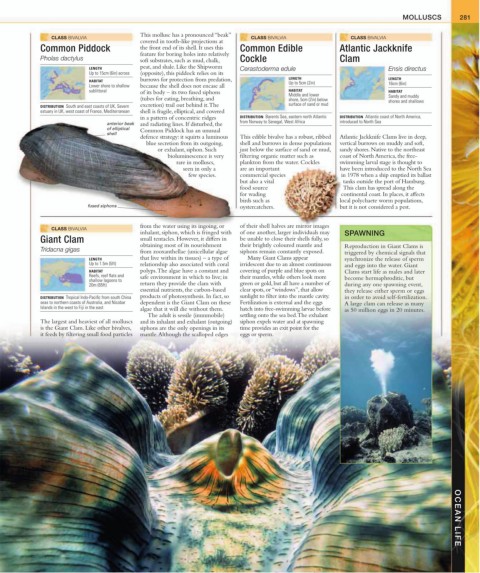
                CLASS BIVALVIA             This mollusc has a pronounced “beak”   CLASS BIVALVIA         CLASS BIVALVIA
                                           covered in tooth-like projections at
             Common Piddock                the front end of its shell. It uses this   Common Edible    Atlantic Jackknife
                                           feature for boring holes into relatively
             Pholas dactylus               soft substrates, such as mud, chalk,    Cockle             Clam
                           LENGTH          peat, and shale. Like the Shipworm
                           Up to 15cm (6in) across  (opposite), this piddock relies on its   Cerastoderma edule      Ensis directus
                           HABITAT         burrows for protection from predation,      LENGTH                        LENGTH
                                                                                       Up to 5cm (2in)
                           Lower shore to shallow   because the shell does not encase all                            16cm (6in)
                           sublittoral     of its body – its two fused siphons         HABITAT                       HABITAT
                                                                                       Middle and lower              Sandy and muddy
                                           (tubes for eating, breathing, and           shore, 5cm (2in) below        shores and shallows
             DISTRIBUTION  South and east coasts of UK, Severn   excretion) trail out behind it. The    surface of sand or mud
             estuary in UK, west coast of France, Mediterranean  shell is fragile, elliptical, and covered
                                           in a pattern of concentric ridges    DISTRIBUTION  Barents Sea, eastern north Atlantic   DISTRIBUTION  Atlantic coast of North America,
                                                                        from Norway to Senegal, West Africa  introduced to North Sea
                                 anterior beak   and radiating lines. If disturbed, the
                                 of elliptical   Common Piddock has an unusual
                                 shell
                                           defence strategy: it squirts a luminous   This edible bivalve has a robust, ribbed   Atlantic Jackknife Clams live in deep,
                                            blue secretion from its outgoing,    shell and burrows in dense populations   vertical burrows on muddy and soft,
                                                or exhalant, siphon. Such   just below the surface of sand or mud,   sandy shores. Native to the northeast
                                                   bioluminescence is very   filtering organic matter such as   coast of North America, the free-
                                                     rare in molluscs,    plankton from the water. Cockles    swimming larval stage is thought to
                                                       seen in only a    are an important             have been introduced to the North Sea
                                                         few species.   commercial species             in 1978 when a ship emptied its ballast
                                                                        but also a vital               tanks outside the port of Hamburg.
                                                                        food source                    This clam has spread along the
                                                                        for wading                     continental coast. In places, it affects
                                                                        birds such as                 local polychaete worm populations,
                           fused siphons                                oystercatchers.               but it is not considered a pest.

                CLASS BIVALVIA             from the water using its ingoing, or   of their shell halves are mirror images
                                           inhalant, siphon, which is fringed with   of one another, larger individuals may   SPAWNING
             Giant Clam                    small tentacles. However, it differs in   be unable to close their shells fully, so
                                           obtaining most of its nourishment   their brightly coloured mantle and   Reproduction in Giant Clams is
             Tridacna gigas                from zooxanthellae (unicellular algae   siphons remain constantly exposed.   triggered by chemical signals that
                           LENGTH          that live within its tissues) – a type of   Many Giant Clams appear   synchronize the release of sperm
                           Up to 1.5m (5ft)  relationship also associated with coral   irridescent due to an almost continuous   and eggs into the water. Giant
                           HABITAT         polyps. The algae have a constant and   covering of purple and blue spots on   Clams start life as males and later
                           Reefs, reef flats and   safe environment in which to live; in   their mantles, while others look more
                           shallow lagoons to                                                           become hermaphroditic, but
                           20m (65ft)      return they provide the clam with   green or gold, but all have a number of   during any one spawning event,
                                           essential nutrients, the carbon-based   clear spots, or “windows”, that allow   they release either sperm or eggs
             DISTRIBUTION  Tropical Indo-Pacific from south China   products of photosynthesis. In fact, so   sunlight to filter into the mantle cavity.   in order to avoid self-fertilization.
             seas to northern coasts of Australia, and Nicobar   dependent is the Giant Clam on these   Fertilization is external and the eggs   A large clam can release as many
             Islands in the west to Fiji in the east  algae that it will die without them.   hatch into free-swimming larvae before   as 50 million eggs in 20 minutes.
                                             The adult is sessile (immmobile)   settling onto the sea bed. The exhalant
             The largest and heaviest of all molluscs  and its inhalant and exhalant (outgoing)  siphon expels water and at spawning
             is the Giant Clam. Like other bivalves,   siphons are the only openings in its   time provides an exit point for the
             it feeds by filtering small food particles   mantle. Although the scalloped edges   eggs or sperm.                          OCEAN LIFE

