


Page 286 - (DK) Ocean - The Definitive Visual Guide
P. 286
284     ANIMAL LIFE


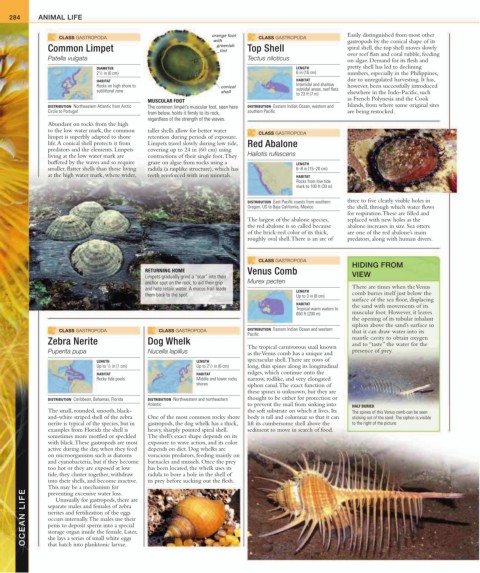
                  CLASS GASTROPODA                              orange foot   CLASS GASTROPODA          Easily distinguished from most other
                                                                with                                    gastropods by the conical shape of its
               Common Limpet                                     greenish   Top Shell                   spiral shell, the top shell moves slowly
                                                                  tint
                                                                                                        over reef flats and coral rubble, feeding
               Patella vulgata                                             Tectus niloticus             on algae. Demand for its flesh and
                              DIAMETER                                                   LENGTH         pretty shell has led to declining
                              1
                              2 / 2 in (6 cm)                                            6 in (16 cm)   numbers, especially in the Philippines,
                              HABITAT                                                    HABITAT        due to unregulated harvesting. It has,
                              Rocks on high shore to               conical               Intertidal and shallow   however, been successfully introduced
                              sublittoral zone                     shell                 subtidal areas, reef flats
                                                                                         to 23 ft (7 m)   elsewhere in the Indo-Pacific, such
                                                                                                        as French Polynesia and the Cook
                                             MUSCULAR FOOT
               DISTRIBUTION  Northeastern Atlantic from Arctic   The common limpet’s muscular foot, seen here   DISTRIBUTION  Eastern Indian Ocean, western and   Islands, from where some original sites
               Circle to Portugal                                          southern Pacific              are being restocked.
                                             from below, holds it firmly to its rock,
                                             regardless of the strength of the waves.
               Abundant on rocks from the high
               to the low water mark, the common   taller shells allow for better water   CLASS GASTROPODA
               limpet is superbly adapted to shore   retention during periods of exposure.
               life. A conical shell protects it from   Limpets travel slowly during low tide,   Red Abalone
               predators and the elements. Limpets   covering up to 24 in (60 cm) using
               living at the low water mark are   contractions of their single foot. They   Haliotis rufescens
               buffeted by the waves and so require   graze on algae from rocks using a   LENGTH
               smaller, flatter shells than those living   radula (a rasplike structure), which has   6–8 in (15–20 cm)
               at the high water mark, where wider,   teeth reinforced with iron minerals.   HABITAT
                                                                                         Rocks from low tide
                                                                                         mark to 100 ft (30 m)
                                                                           DISTRIBUTION  East Pacific coasts from southern   three to five clearly visible holes in
                                                                           Oregon, US to Baja California, Mexico  the shell, through which water flows
                                                                                                        for respiration.These are filled and
                                                                           The largest of the abalone species,    replaced with new holes as the
                                                                           the red abalone is so called because    abalone increases in size. Sea otters
                                                                           of the brick-red color of its thick,   are one of the red abalone’s main
                                                                           roughly oval shell. There is an arc of   predators, along with human divers.


                                                                              CLASS GASTROPODA
                                                                                                          HIDING FROM
                                            RETURNING HOME                 Venus Comb
                                            Limpets gradually grind a “scar” into their                   VIEW
                                            anchor spot on the rock, to aid their grip   Murex pecten
                                            and help retain water. A mucus trail leads                    There are times when the Venus
                                                                                         LENGTH
                                            them back to the spot.                       Up to 3 in (8 cm)  comb buries itself just below the
                                                                                                          surface of the sea floor, displacing
                                                                                         HABITAT          the sand with movements of its
                                                                                         Tropical warm waters to
                                                                                         650 ft (200 m)   muscular foot. However, it leaves
                                                                                                          the opening of its tubular inhalant
                                                                                                          siphon above the sand’s surface so
                  CLASS GASTROPODA              CLASS GASTROPODA           DISTRIBUTION  Eastern Indian Ocean and western   that it can draw water into its
                                                                           Pacific
               Zebra Nerite                  Dog Whelk                                                    mantle cavity to obtain oxygen
                                                                                                          and to “taste” the water for the
                                                                           The tropical carnivorous snail known
               Puperita pupa                 Nucella lapillus              as the Venus comb has a unique and   presence of prey.
                              LENGTH                       LENGTH          spectacular shell. There are rows of
                                                               1
                                 1
                              Up to  / 2 in (1 cm)         Up to 2 / 2 in (6 cm)  long, thin spines along its longitudinal
                              HABITAT                      HABITAT         ridges, which continue onto the
                              Rocky tide pools             Middle and lower rocky   narrow, rodlike, and very elongated
                                                           shores          siphon canal. The exact function of
                                                                           these spines is unknown, but they are
               DISTRIBUTION  Caribbean, Bahamas, Florida  DISTRIBUTION  Northwestern and northeastern   thought to be either for protection or
                                             Atlantic                      to prevent the snail from sinking into   HALF BURIED
               The small, rounded, smooth, black-                          the soft substrate on which it lives. Its   The spines of this Venus comb can be seen
               and-white striped shell of the zebra   One of the most common rocky shore  body is tall and columnar so that it can   sticking out of the sand. The siphon is visible
               nerite is typical of the species, but in   gastropods, the dog whelk has a thick,   lift its cumbersome shell above the   to the right of the picture.
               examples from Florida the shell is   heavy, sharply pointed spiral shell.    sediment to move in search of food.
               sometimes more mottled or speckled   The shell’s exact shape depends on its
               with black. These gastropods are most   exposure to wave action, and its color
               active during the day, when they feed   depends on diet. Dog whelks are
               on microorganisms such as diatoms   voracious predators, feeding mainly on
               and cyanobacteria, but if they become   barnacles and mussels. Once the prey
               too hot or they are exposed at low   has been located, the whelk uses its
               tide, they cluster together, withdraw   radula to bore a hole in the shell of
               into their shells, and become inactive.   its prey before sucking out the flesh.
               This may be a mechanism for
        OCEAN LIFE  separate males and females of zebra
               preventing excessive water loss.
                 Unusually for gastropods, there are
               nerites and fertilization of the eggs
               occurs internally. The males use their
               penis to deposit sperm into a special
               storage organ inside the female. Later,
               she lays a series of small white eggs
               that hatch into planktonic larvae.

