Page 287 - (DK) Ocean - The Definitive Visual Guide
P. 287
MOLLUSKS         285


                                                                                                         CLASS GASTROPODA
                                                                                                      Tiger Cowrie

                                                                                                      Cypraea tigris
                                                                                                                     LENGTH
                                                                                                                     Up to 6 in (15 cm)
                                                                                                                     HABITAT
                                                                                                                     Low tide to 100 ft (30 m)
                                                                                                                     on coral reefs and flats
                                                                                                      DISTRIBUTION  Indian Ocean, western Pacific
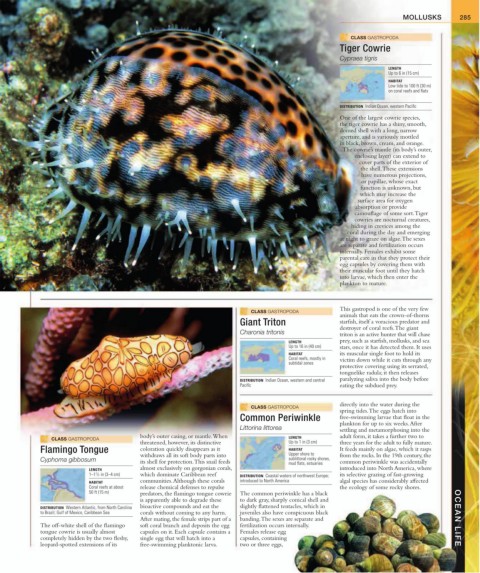
                                                                                                      One of the largest cowrie species,
                                                                                                      the tiger cowrie has a shiny, smooth,
                                                                                                      domed shell with a long, narrow
                                                                                                      aperture, and is variously mottled
                                                                                                      in black, brown, cream, and orange.
                                                                                                       The cowrie’s mantle (its body’s outer,
                                                                                                           enclosing layer) can extend to
                                                                                                            cover parts of the exterior of
                                                                                                            the shell. These extensions
                                                                                                             have numerous projections,
                                                                                                             or papillae, whose exact
                                                                                                            function is unknown, but
                                                                                                            which may increase the
                                                                                                            surface area for oxygen
                                                                                                           absorption or provide
                                                                                                           camouflage of some sort. Tiger
                                                                                                           cowries are nocturnal creatures,
                                                                                                          hiding in crevices among the
                                                                                                        coral during the day and emerging
                                                                                                      at night to graze on algae. The sexes
                                                                                                      are separate and fertilization occurs
                                                                                                      internally. Females exhibit some
                                                                                                      parental care in that they protect their
                                                                                                      egg capsules by covering them with
                                                                                                      their muscular foot until they hatch
                                                                                                      into larvae, which then enter the
                                                                                                      plankton to mature.


                                                                            CLASS GASTROPODA          This gastropod is one of the very few
                                                                                                      animals that eats the crown-of-thorns
                                                                        Giant Triton                  starfish, itself a voracious predator and
                                                                                                      destroyer of coral reefs. The giant
                                                                        Charonia tritonis             triton is an active hunter that will chase
                                                                                       LENGTH         prey, such as starfish, mollusks, and sea
                                                                                       Up to 16 in (40 cm)  stars, once it has detected them. It uses
                                                                                       HABITAT        its muscular single foot to hold its
                                                                                       Coral reefs, mostly in   victim down while it cuts through any
                                                                                       subtidal zones
                                                                                                      protective covering using its serrated,
                                                                                                      tonguelike radula; it then releases
                                                                        DISTRIBUTION  Indian Ocean, western and central   paralyzing saliva into the body before
                                                                        Pacific                        eating the subdued prey.

                                                                            CLASS GASTROPODA          directly into the water during the
                                                                                                      spring tides. The eggs hatch into
                                                                        Common Periwinkle             free-swimming larvae that float in the
                                                                                                      plankton for up to six weeks. After
                                                                        Littorina littorea            settling and metamorphosing into the
                                           body’s outer casing, or mantle. When                       adult form, it takes a further two to
                CLASS GASTROPODA                                                       LENGTH
                                           threatened, however, its distinctive        Up to 1 in (3 cm)  three years for the adult to fully mature.
             Flamingo Tongue               coloration quickly disappears as it         HABITAT        It feeds mainly on algae, which it rasps
                                           withdraws all its soft body parts into      Upper shore to   from the rocks. In the 19th century, the
                                                                                       sublittoral rocky shores,
                                           its shell for protection. This snail feeds
             Cyphoma gibbosum                                                          mud flats, estuaries    common periwinkle was accidentally
                           LENGTH          almost exclusively on gorgonian corals,                    introduced into North America, where
                             1
                           1–1 / 2 in (3–4 cm)  which dominate Caribbean reef   DISTRIBUTION  Coastal waters of northwest Europe;   its selective grazing of fast-growing
                           HABITAT         communities. Although these corals   introduced to North America  algal species has considerably affected
                           Coral reefs at about    release chemical defenses to repulse               the ecology of some rocky shores.
                           50 ft (15 m)    predators, the flamingo tongue cowrie   The common periwinkle has a black
                                           is apparently able to degrade these   to dark gray, sharply conical shell and
             DISTRIBUTION  Western Atlantic, from North Carolina   bioactive compounds and eat the   slightly flattened tentacles, which in
             to Brazil; Gulf of Mexico, Caribbean Sea  corals without coming to any harm.   juveniles also have conspicuous black
                                           After mating, the female strips part of a   banding. The sexes are separate and               OCEAN LIFE
             The off-white shell of the flamingo   soft coral branch and deposits the egg   fertilization occurs internally.
             tongue cowrie is usually almost   capsules on it. Each capsule contains a   Females release egg
             completely hidden by the two fleshy,   single egg that will hatch into a   capsules, containing
             leopard-spotted extensions of its   free-swimming planktonic larva.  two or three eggs,
   282   283   284   285   286   287   288   289   290   291   292