Page 288 - (DK) Ocean - The Definitive Visual Guide
P. 288
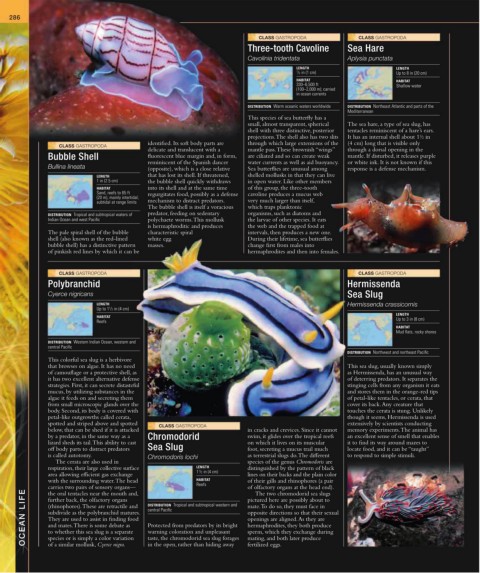
286


                                                                              CLASS GASTROPODA              CLASS GASTROPODA
                                                                           Three-tooth Cavoline          Sea Hare

                                                                           Cavolinia tridentata          Aplysia punctata
                                                                                         LENGTH                        LENGTH
                                                                                         1 / 2 in (1 cm)
                                                                                                                       Up to 8 in (20 cm)
                                                                                         HABITAT                       HABITAT
                                                                                         330–6,500 ft                  Shallow water
                                                                                         (100–2,000 m); carried
                                                                                         in ocean currents
                                                                           DISTRIBUTION  Warm oceanic waters worldwide  DISTRIBUTION  Northeast Atlantic and parts of the
                                                                                                         Mediterranean
                                                                           This species of sea butterfly has a
                                                                           small, almost transparent, spherical   The sea hare, a type of sea slug, has
                                                                           shell with three distinctive, posterior   tentacles reminiscent of a hare’s ears.
                                                                                                                              1
                                                                           projections. The shell also has two slits   It has an internal shell about 1/2 in
                                             identified. Its soft body parts are   through which large extensions of the   (4 cm) long that is visible only
                  CLASS GASTROPODA
                                             delicate and translucent with a   mantle pass. These brownish “wings”   through a dorsal opening in the
               Bubble Shell                  fluorescent blue margin and, in form,   are ciliated and so can create weak   mantle. If disturbed, it releases purple
                                             reminiscent of the Spanish dancer   water currents as well as aid buoyancy.   or white ink. It is not known if this
                                             (opposite), which is a close relative   Sea butterflies are unusual among    response is a defense mechanism.
               Bullina lineata
                              LENGTH         that has lost its shell. If threatened,    shelled mollusks in that they can live
                              1 in (2.5 cm)  the bubble shell quickly withdraws   in open water. Like other members
                              HABITAT        into its shell and at the same time   of this group, the three-tooth
                              Sand, reefs to 65 ft   regurgitates food, possibly as a defense   cavoline produces a mucus web
                              (20 m), mainly intertidal;
                              subtidal at range limits   mechanism to distract predators.    very much larger than itself,
                                             The bubble shell is itself a voracious   which traps planktonic
               DISTRIBUTION  Tropical and subtropical waters of   predator, feeding on sedentary   organisms, such as diatoms and
               Indian Ocean and west Pacific  polychaete worms. This mollusk    the larvae of other species. It eats
                                             is hermaphroditic and produces   the web and the trapped food at
               The pale spiral shell of the bubble   characteristic spiral   intervals, then produces a new one.
               shell (also known as the red-lined   white egg              During their lifetime, sea butterflies
               bubble shell) has a distinctive pattern   masses.           change first from males into
               of pinkish red lines by which it can be                     hermaphrodites and then into females.

                  CLASS GASTROPODA                                                                          CLASS GASTROPODA
               Polybranchid                                                                             Hermissenda
                                                                                                        Sea Slug
               Cyerce nigricans
                              LENGTH
                                                                                                        Hermissenda crassicornis
                              Up to 1 / 2 in (4 cm)
                                 1
                                                                                                                       LENGTH
                              HABITAT
                              Reefs                                                                                    Up to 3 in (8 cm)
                                                                                                                       HABITAT
                                                                                                                       Mud flats, rocky shores
               DISTRIBUTION  Western Indian Ocean, western and
               central Pacific
                                                                                                        DISTRIBUTION  Northwest and northeast Pacific
               This colorful sea slug is a herbivore
               that browses on algae. It has no need                                                    This sea slug, usually known simply
               of camouflage or a protective shell, as                                                  as Hermissenda, has an unusual way
               it has two excellent alternative defense                                                 of deterring predators. It separates the
               strategies. First, it can secrete distasteful                                            stinging cells from any organism it eats
               mucus, by utilizing substances in the                                                    and stores them in the orange-red tips
               algae it feeds on and secreting them                                                     of petal-like tentacles, or cerata, that
               from small microscopic glands over the                                                   cover its back. Any creature that
               body. Second, its body is covered with                                                   touches the cerata is stung. Unlikely
               petal-like outgrowths called cerata,                                                     though it seems, Hermissenda is used
               spotted and striped above and spotted   CLASS GASTROPODA                                 extensively by scientists conducting
               below, that can be shed if it is attacked                   in cracks and crevices. Since it cannot   memory experiments. The animal has
               by a predator, in the same way as a   Chromodorid           swim, it glides over the tropical reefs   an excellent sense of smell that enables
               lizard sheds its tail. This ability to cast                 on which it lives on its muscular    it to find its way around mazes to
               off body parts to distract predators    Sea Slug            foot, secreting a mucus trail much    locate food, and it can be “taught”
               is called autotomy.                                         as terrestrial slugs do. The different   to respond to simple stimuli.
                 The cerata are also used in   Chromodoris lochi           species of the genus Chromodoris are
               respiration, their large collective surface   LENGTH        distinguished by the pattern of black
               area allowing efficient gas exchange        1 1 / 2 in (4 cm)  lines on their backs and the plain color
               with the surrounding water. The head        HABITAT         of their gills and rhinophores (a pair
               carries two pairs of sensory organs—        Reefs           of olfactory organs at the head end).
        OCEAN LIFE  (rhinophores). These are retractile and   DISTRIBUTION  Tropical and subtropical western and   mate. To do so, they must face in
                                                                             The two chromodorid sea slugs
               the oral tentacles near the mouth and,
               further back, the olfactory organs
                                                                           pictured here are possibly about to
                                             central Pacific
               subdivide as the polybranchid matures.
                                                                           opposite directions so that their sexual
                                                                           openings are aligned. As they are
               They are used to assist in finding food
                                             Protected from predators by its bright
               and mates. There is some debate as
                                                                           hermaphrodites, they both produce
                                                                           sperm, which they exchange during
                                             warning coloration and unpleasant
               to whether this sea slug is a separate
               species or is simply a color variation
                                             taste, the chromodorid sea slug forages
                                                                           mating, and both later produce
                                                                           fertilized eggs.
                                             in the open, rather than hiding away
               of a similar mollusk, Cyerce nigra.
   283   284   285   286   287   288   289   290   291   292   293