


Page 311 - (DK) Ocean - The Definitive Visual Guide
P. 311
ECHINODERMS          309


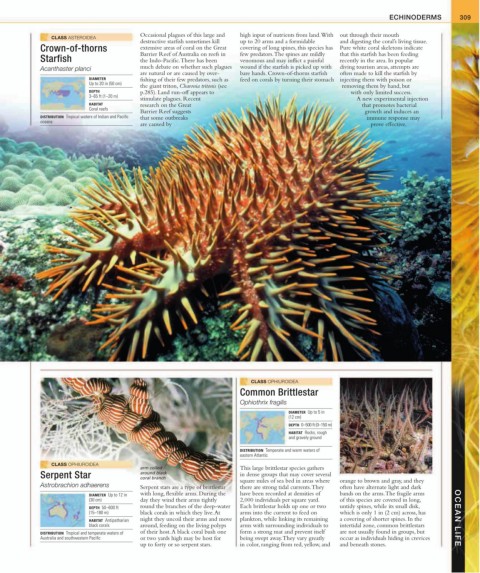
                CLASS ASTEROIDEA           Occasional plagues of this large and   high input of nutrients from land. With  out through their mouth
                                           destructive starfish sometimes kill   up to 20 arms and a formidable   and digesting the coral’s living tissue.
             Crown-of-thorns               extensive areas of coral on the Great   covering of long spines, this species has  Pure white coral skeletons indicate
                                           Barrier Reef of Australia on reefs in   few predators. The spines are mildly   that this starfish has been feeding
             Starfish                      the Indo-Pacific. There has been   venomous and may inflict a painful   recently in the area. In popular
                                           much debate on whether such plagues   wound if the starfish is picked up with   diving tourism areas, attempts are
             Acanthaster planci
                                           are natural or are caused by over-  bare hands. Crown-of-thorns starfish   often made to kill the starfish by
                           DIAMETER        fishing of their few predators, such as   feed on corals by turning their stomach  injecting them with poison or
                           Up to 20 in (50 cm)
                                           the giant triton, Charonia tritonis (see                    removing them by hand, but
                           DEPTH           p.285). Land run-off appears to                               with only limited success.
                           3–65 ft (1–20 m)
                                           stimulate plagues. Recent                                       A new experimental injection
                           HABITAT         research on the Great                                             that promotes bacterial
                           Coral reefs
                                           Barrier Reef suggests                                              growth and induces an
             DISTRIBUTION  Tropical waters of Indian and Pacific   that some outbreaks                         immune response may
             oceans
                                           are caused by                                                       prove effective.


                                                                            CLASS OPHIUROIDEA
                                                                        Common Brittlestar

                                                                        Ophiothrix fragilis
                                                                                       DIAMETER  Up to 5 in
                                                                                       (12 cm)
                                                                                       DEPTH  0–500 ft (0–150 m)
                                                                                       HABITAT  Rocks, rough
                                                                                       and gravely ground

                                                                        DISTRIBUTION  Temperate and warm waters of
                                                                        eastern Atlantic
                CLASS OPHIUROIDEA
                                           arm coiled                   This large brittlestar species gathers
             Serpent Star                  around black                 in dense groups that may cover several
                                           coral branch
                                                                        square miles of sea bed in areas where   orange to brown and gray, and they
                                           Serpent stars are a type of brittlestar   there are strong tidal currents. They   often have alternate light and dark
             Astrobrachion adhaerens
                           DIAMETER  Up to 12 in   with long, flexible arms. During the   have been recorded at densities of   bands on the arms. The fragile arms
                           (30 cm)         day they wind their arms tightly   2,000 individuals per square yard.   of this species are covered in long,
                           DEPTH  50–600 ft   round the branches of the deep-water   Each brittlestar holds up one or two   untidy spines, while its small disk,
                           (15–180 m)      black corals in which they live. At   arms into the current to feed on   which is only 1 in (2 cm) across, has
                           HABITAT  Antipatharian   night they uncoil their arms and move   plankton, while linking its remaining   a covering of shorter spines. In the   OCEAN LIFE
                           black corals    around, feeding on the living polyps   arms with surrounding individuals to   intertidal zone, common brittlestars
             DISTRIBUTION  Tropical and temperate waters of   of their host. A black coral bush one   form a strong mat and prevent itself   are not usually found in groups, but
             Australia and southwestern Pacific  or two yards high may be host for    being swept away. They vary greatly    occur as individuals hiding in crevices
                                           up to forty or so serpent stars.  in color, ranging from red, yellow, and   and beneath stones.

