


Page 318 - (DK) Ocean - The Definitive Visual Guide
P. 318
316     ANIMAL LIFE


                  PHYLUM TARDIGRADA
                                                         claw
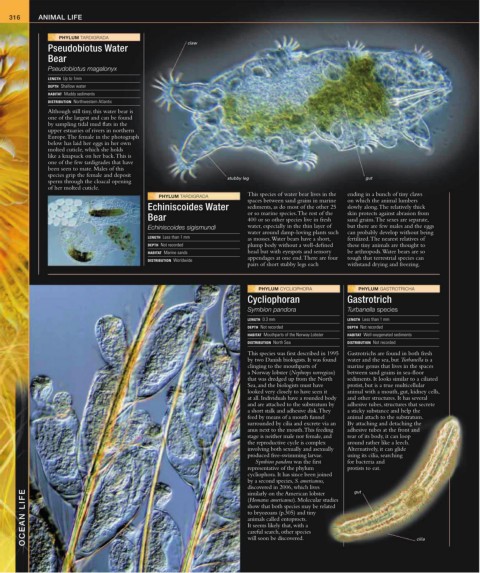
               Pseudobiotus Water
               Bear

               Pseudobiotus magalonyx
               LENGTH  Up to 1mm
               DEPTH  Shallow water
               HABITAT  Muddy sediments
               DISTRIBUTION  Northwestern Atlantic
               Although still tiny, this water bear is
               one of the largest and can be found
               by sampling tidal mud flats in the
               upper estuaries of rivers in northern
               Europe. The female in the photograph
               below has laid her eggs in her own
               molted cuticle, which she holds
               like a knapsack on her back. This is
               one of the few tardigrades that have
               been seen to mate. Males of this
               species grip the female and deposit                                                            gut
               sperm through the cloacal opening                     stubby leg
               of her molted cuticle.
                                                PHYLUM TARDIGRADA          This species of water bear lives in the   ending in a bunch of tiny claws
                                                                           spaces between sand grains in marine   on which the animal lumbers
                                             Echiniscoides Water           sediments, as do most of the other 25   slowly along. The relatively thick
                                                                           or so marine species. The rest of the   skin protects against abrasion from
                                             Bear                          400 or so other species live in fresh   sand grains. The sexes are separate,
                                                                           water, especially in the thin layer of   but there are few males and the eggs
                                             Echiniscoides sigismundi
                                                                           water around damp-loving plants such   can probably develop without being
                                             LENGTH  Less than 1 mm        as mosses. Water bears have a short,   fertilized. The nearest relatives of
                                             DEPTH  Not recorded           plump body without a well-defined   these tiny animals are thought to
                                             HABITAT  Marine sands         head but with eyespots and sensory   be arthropods. Water bears are so
                                                                           appendages at one end. There are four   tough that terrestrial species can
                                             DISTRIBUTION  Worldwide
                                                                           pairs of short stubby legs each    withstand drying and freezing.

                                                                              PHYLUM CYCLIOPHORA            PHYLUM GASTROTRICHA
                                                                           Cycliophoran                 Gastrotrich
                                                                                                        Turbanella species
                                                                           Symbion pandora
                                                                           LENGTH  0.3 mm               LENGTH  Less than 1 mm
                                                                           DEPTH  Not recorded          DEPTH  Not recorded
                                                                           HABITAT  Mouthparts of the Norway Lobster  HABITAT  Well-oxygenated sediments
                                                                           DISTRIBUTION  North Sea      DISTRIBUTION  Not recorded
                                                                           This species was first described in 1995   Gastrotrichs are found in both fresh
                                                                           by two Danish biologists. It was found   water and the sea, but Turbanella is a
                                                                           clinging to the mouthparts of    marine genus that lives in the spaces
                                                                           a Norway lobster (Nephrops norvegicus)   between sand grains in sea-floor
                                                                           that was dredged up from the North   sediments. It looks similar to a ciliated
                                                                           Sea, and the biologists must have   protist, but is a true multicellular
                                                                           looked very closely to have seen it    animal with a mouth, gut, kidney cells,
                                                                           at all. Individuals have a rounded body   and other structures. It has several
                                                                           and are attached to the substratum by    adhesive tubes, structures that secrete
                                                                           a short stalk and adhesive disk. They   a sticky substance and help the
                                                                           feed by means of a mouth funnel   animal attach to the substratum.
                                                                           surrounded by cilia and excrete via an   By attaching and detaching the
                                                                           anus next to the mouth. This feeding   adhesive tubes at the front and
                                                                           stage is neither male nor female, and   rear of its body, it can loop
                                                                           the reproductive cycle is complex   around rather like a leech.
                                                                           involving both sexually and asexually   Alternatively, it can glide
                                                                           produced free-swimming larvae.  using its cilia, searching
                                                                             Symbion pandora was the first   for bacteria and
                                                                           representative of the phylum   protists to eat.
                                                                           cycliophora. It has since been joined
                                                                           by a second species, S. americanus,
                                                                           discovered in 2006, which lives   gut
        OCEAN LIFE                                                         show that both species may be related             cilia
                                                                           similarly on the American lobster
                                                                           (Homarus americanus). Molecular studies
                                                                           to bryozoans (p.305) and tiny
                                                                           animals called entoprocts.
                                                                           It seems likely that, with a
                                                                           careful search, other species
                                                                           will soon be discovered.

