


Page 320 - (DK) Ocean - The Definitive Visual Guide
P. 320
318     ANIMAL LIFE


               Tunicates and Lancelets                                                    Anatomy

                                                                                          When tunicate larvae become adults, they lose the
                                       TUNICATES HAVE A LONG, baglike body often
                   DOMAIN  Eucarya                                                        supporting notochord, but lancelets keep it during
                                       attached to the sea floor; lancelets resemble small, stiff   the adult stage. Tunicates are covered by a tough
                  KINGDOM Animalia
                                       worms and live buried in sediment. Despite their simple  protective bag made out of cellulose called a tunic,
                   PHYLUM Chordata
                                       appearance, these animals are included not with the   which sticks to the sea floor by means of rootlike
                  SUBPHYLA  Tunicata   world’s other invertebrates but in the same group as   projections. Inside is a big sievelike structure, the
                        Cephalochordata                                                   pharynx, which connects the mouth and gut. This
                                       backboned animals such as fish and mammals. This is
                   CLASSES 5           because, uniquely among invertebrates, tunicates and   has a sticky mucus coating to trap plankton from
                                                                                          the seawater passing through it. Lancelets also filter
                   SPECIES About 3,056  lancelets possess an internal skeletal rod, or notochord.
                                                                                          water through a pharynx, expelling it through an
                                       The best-known tunicates are sea squirts, some of which
                                                                                          opening near the anus. A ring of stiff hairs (cirri)
                                       form colonies, whereas lancelets are all solitary.  surrounding their mouth prevents sand getting in.
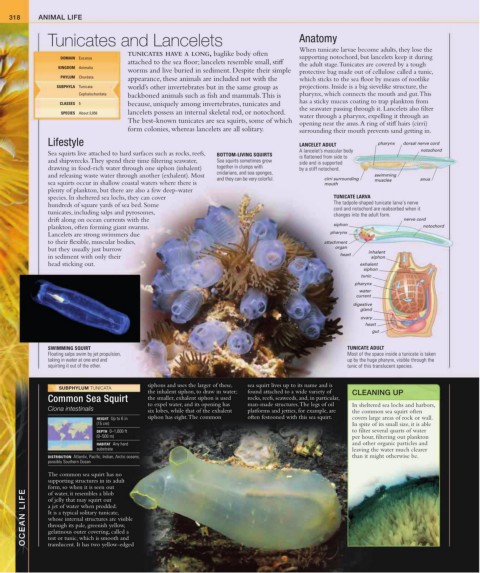
               Lifestyle                                                                  LANCELET ADULT          pharynx  dorsal nerve cord
               Sea squirts live attached to hard surfaces such as rocks, reefs,   BOTTOM-LIVING SQUIRTS  A lancelet’s muscular body   notochord
                                                                                          is flattened from side to
               and shipwrecks. They spend their time filtering seawater,   Sea squirts sometimes grow   side and is supported
               drawing in food-rich water through one siphon (inhalent)   together in clumps with   by a stiff notochord.
               and releasing waste water through another (exhalent). Most   cnidarians, and sea sponges,         swimming
                                                                  and they can be very colorful.  cirri surrounding   muscles  anus
               sea squirts occur in shallow coastal waters where there is                         mouth
               plenty of plankton, but there are also a few deep-water
               species. In sheltered sea lochs, they can cover                                      TUNICATE LARVA
               hundreds of square yards of sea bed. Some                                            The tadpole-shaped tunicate larva‘s nerve
                                                                                                    cord and notochord are reabsorbed when it
               tunicates, including salps and pyrosomes,                                            changes into the adult form.
               drift along on ocean currents with the                                                                    nerve cord
               plankton, often forming giant swarms.                                                siphon                     notochord
               Lancelets are strong swimmers due                                                   pharynx
               to their flexible, muscular bodies,                                                attachment
               but they usually just burrow                                                          organ     inhalent
               in sediment with only their                                                            heart     siphon
               head sticking out.                                                                           exhalent
                                                                                                             siphon
                                                                                                             tunic
                                                                                                           pharynx
                                                                                                            water
                                                                                                           current
                                                                                                          digestive
                                                                                                            gland
                                                                                                            ovary
                                                                                                              heart
                                                                                                                gut

               SWIMMING SQUIRT                                                                          TUNICATE ADULT
               Floating salps swim by jet propulsion,                                                   Most of the space inside a tunicate is taken
               taking in water at one end and                                                           up by the huge pharynx, visible through the
               squirting it out of the other.                                                           tunic of this translucent species.

                                             siphons and uses the larger of these,   sea squirt lives up to its name and is
                  SUBPHYLUM TUNICATA
                                             the inhalent siphon, to draw in water;   found attached to a wide variety of   CLEANING UP
               Common Sea Squirt             the smaller, exhalent siphon is used    rocks, reefs, seaweeds, and, in particular,
                                             to expel water, and its opening has    man-made structures. The legs of oil   In sheltered sea lochs and harbors,
                                             six lobes, while that of the exhalent   platforms and jetties, for example, are
               Ciona intestinalis                                                                         the common sea squirt often
                              HEIGHT  Up to 6 in   siphon has eight. The common    often festooned with this sea squirt.  covers large areas of rock or wall.
                              (15 cm)                                                                     In spite of its small size, it is able
                              DEPTH  0–1,600 ft                                                           to filter several quarts of water
                              (0–500 m)                                                                   per hour, filtering out plankton
                              HABITAT  Any hard                                                           and other organic particles and
                              substrate                                                                   leaving the water much clearer
               DISTRIBUTION  Atlantic, Pacific, Indian, Arctic oceans;                                     than it might otherwise be.
               possibly Southern Ocean
               The common sea squirt has no
               supporting structures in its adult
               form, so when it is seen out
        OCEAN LIFE  a jet of water when prodded.
               of water, it resembles a blob
               of jelly that may squirt out
               It is a typical solitary tunicate,
               whose internal structures are visible
               through its pale, greenish yellow,
               gelatinous outer covering, called a
               test or tunic, which is smooth and
               translucent. It has two yellow-edged

