Page 321 - (DK) Ocean - The Definitive Visual Guide
P. 321
TUNICATES AND LANCELETS            319


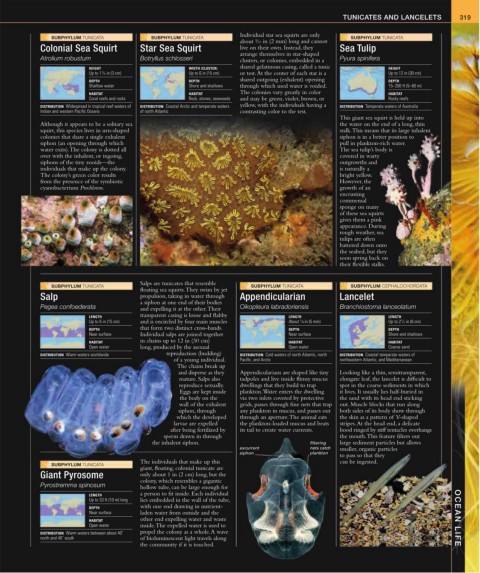
                SUBPHYLUM TUNICATA            SUBPHYLUM TUNICATA        Individual star sea squirts are only   SUBPHYLUM TUNICATA
                                                                        about /32 in (2 mm) long and cannot
                                                                             3
             Colonial Sea Squirt           Star Sea Squirt              live on their own. Instead, they   Sea Tulip
                                                                        arrange themselves in star-shaped
             Atrolium robustum             Botryllus schlosseri         clusters, or colonies, embedded in a   Pyura spinifera
                           HEIGHT                        WIDTH (CLUSTER)     shared gelatinous casing, called a tunic   HEIGHT
                               1
                           Up to 1 / 4 in (3 cm)         Up to 6 in (15 cm)  or test. At the center of each star is a   Up to 12 in (30 cm)
                           DEPTH                         DEPTH          shared outgoing (exhalent) opening           DEPTH
                           Shallow water                 Shore and shallows  through which used water is voided.     15–200 ft (5–60 m)
                           HABITAT                       HABITAT        The colonies vary greatly in color           HABITAT
                           Coral reefs and rocks         Rock, stones, seaweeds  and may be green, violet, brown, or   Rocky reefs
             DISTRIBUTION  Widespread in tropical reef waters of   DISTRIBUTION  Coastal Arctic and temperate waters   yellow, with the individuals having a   DISTRIBUTION  Temperate waters of Australia
             Indian and western Pacific Oceans  of north Atlantic        contrasting color to the test.
                                                                                                      This giant sea squirt is held up into
             Although it appears to be a solitary sea                                                 the water on the end of a long, thin
             squirt, this species lives in urn-shaped                                                 stalk. This means that its large inhalent
             colonies that share a single exhalent                                                    siphon is in a better position to
             siphon (an opening through which                                                         pull in plankton-rich water.
             water exits). The colony is dotted all                                                   The sea tulip’s body is
             over with the inhalent, or ingoing,                                                      covered in warty
             siphons of the tiny zooids—the                                                           outgrowths and
             individuals that make up the colony.                                                     is naturally a
             The colony’s green color results                                                         bright yellow.
             from the presence of the symbiotic                                                       However, the
             cyanobacterium Prochloron.                                                               growth of an
                                                                                                      encrusting
                                                                                                      commensal
                                                                                                      sponge on many
                                                                                                      of these sea squirts
                                                                                                      gives them a pink
                                                                                                      appearance. During
                                                                                                      rough weather, sea
                                                                                                      tulips are often
                                                                                                      battered down onto
                                                                                                      the seabed, but they
                                                                                                      soon spring back on
                                                                                                      their flexible stalks.

                                           Salps are tunicates that resemble
                SUBPHYLUM TUNICATA                                          SUBPHYLUM TUNICATA           SUBPHYLUM CEPHALOCHORDATA
                                           floating sea squirts. They swim by jet
             Salp                          propulsion, taking in water through   Appendicularian      Lancelet
                                           a siphon at one end of their bodies
                                           and expelling it at the other. Their
             Pegea confoederata                                         Oikopleura labradoriensis     Branchiostoma lanceolatum
                           LENGTH          transparent casing is loose and flabby      LENGTH                        LENGTH
                           Up to 6 in (15 cm)  and is encircled by four main muscles   About  / 4 in (5 mm)          Up to 2 / 2 in (6 cm)
                                                                                          1
                                                                                                                        1
                           DEPTH           that form two distinct cross-bands.         DEPTH                         DEPTH
                           Near surface    Individual salps are joined together        Near surface                  Shore and shallows
                           HABITAT         in chains up to 12 in (30 cm)               HABITAT                       HABITAT
                           Open water      long, produced by the asexual               Open water                    Coarse sand
             DISTRIBUTION  Warm waters worldwide  reproduction (budding)   DISTRIBUTION  Cold waters of north Atlantic, north   DISTRIBUTION  Coastal temperate waters of
                                                     of a young individual.   Pacific, and Arctic      northeastern Atlantic, and Mediterranean
                                                      The chains break up
                                                      and disperse as they   Appendicularians are shaped like tiny   Looking like a thin, semitransparent,
                                                      mature. Salps also   tadpoles and live inside flimsy mucus   elongate leaf, the lancelet is difficult to
                                                      reproduce sexually.   dwellings that they build to trap   spot in the coarse sediments in which
                                                      Eggs are kept inside   plankton. Water enters the dwelling   it lives. It usually lies half-buried in
                                                      the body on the   via two inlets covered by protective   the sand with its head end sticking
                                                      wall of the exhalent   grids, passes through fine nets that trap   out. Muscle blocks that run along
                                                      siphon, through   any plankton in mucus, and passes out   both sides of its body show through
                                                     which the developed   through an aperture. The animal eats   the skin as a pattern of  V-shaped
                                                     larvae are expelled   the plankton-loaded mucus and beats   stripes. At the head end, a delicate
                                                    after being fertilized by   its tail to create water currents.  hood ringed by stiff tentacles overhangs
                                                  sperm drawn in through                              the mouth. This feature filters out
                                              the inhalent siphon.                           filtering    large sediment particles but allows
                                                                        excurrent            nets catch   smaller, organic particles
                                                                        siphon               plankton
                                                                                                      to pass so that they
                                           The individuals that make up this                          can be ingested.
                SUBPHYLUM TUNICATA
                                           giant, floating, colonial tunicate are
             Giant Pyrosome                only about 1 in (2 cm) long, but the
                                           colony, which resembles a gigantic
             Pyrostremma spinosum          hollow tube, can be large enough for
                           LENGTH          a person to fit inside. Each individual
                           Up to 33 ft (10 m) long  lies embedded in the wall of the tube,
                           DEPTH           with one end drawing in nutrient-
                           Near surface    laden water from outside and the
                           HABITAT         other end expelling water and waste                                                           OCEAN LIFE
                           Open water      inside. The expelled water is used to
             DISTRIBUTION  Warm waters between about 40˚   propel the colony as a whole. A wave
             north and 40˚ south           of bioluminescent light travels along
                                           the community if it is touched.
   316   317   318   319   320   321   322   323   324   325   326