


Page 317 - (DK) Ocean - The Definitive Visual Guide
P. 317
SMALL, BOTTOM-LIVING PHYLA            315


                PHYLUM CEPHALORHYNCHA         PHYLUM VESTIMENTIFERA     pulling itself down with its pedicle.
                                                                        Fossils of brachiopods with a similar
             Mud Dragon                    Linguid Brachiopod           shape appear in rocks that are
                                                                        500 million years old.
             Echinoderes aquilonius        Glottidia albida
             LENGTH  Less than 1mm         HEIGHT  1 in (2 cm)
             DEPTH  Shallow water          DEPTH  0–1,476 ft (0–450 m )
             HABITAT  Muddy sediments      HABITAT  Subtidal sediment
             DISTRIBUTION  Northwestern Atlantic  DISTRIBUTION  Coastal waters of northeastern
                                           Pacific, California to Mexico
             Mud dragons resemble miniature insect
             pupae. The body appears segmented on   Linguid brachiopods resemble small
             the outside but this is superficial. It is   clams with strange long tails. The tail
             covered with a thick, articulated cuticle   is, in fact, a stalk, known as a pedicle,
             and sharp spines on each body section.   that emerges from between the
             The tail end has a bunch of longer   brachiopod’s shell valves.
             spines, and the head region has several   Brachiopods have a two-part
             rings of spines. The mouth is situated   shell similar to a clam, but these
             on the end of a cone-shaped structure.    two types of animals are not closely
             The animal can withdraw the entire   related. Many brachiopods use
             head region into the rest of the body   their pedicle to attach to rocks
             for protection, but it can also close the   (see lamp shell below), but lingulid
             resulting hole with special plates, which   brachiopods live in burrows in
             are called placids. The head spines help   sand and mud. The pedicle is two
             the animal to push its way through the   to three times the length of the
             sediment, feeding on organic debris,   shell and is used to make a burrow
             bacteria, protists, and diatoms.   in the soft sediment in which it
             The 100–150 species of mud dragons   lives. When filtering plankton from
             are all marine. The sexes are separate   the water it comes to the top of
             but look similar. The eggs develop into   the burrow and opens its shell
             free-living larvae that moult several   using special muscles, but the linguid
             times before attaining the adult form.  brachiopod can quickly disappear by


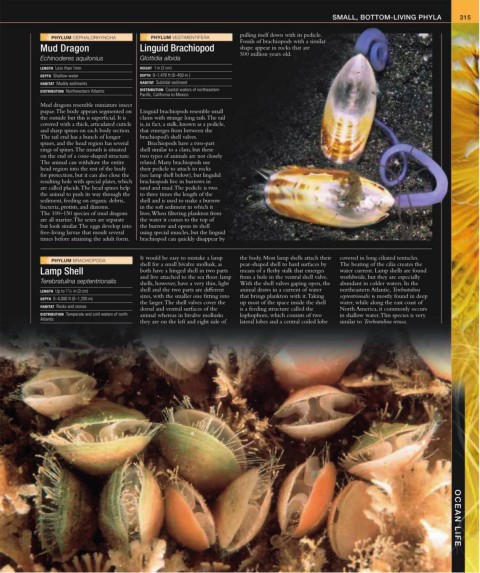
                                           It would be easy to mistake a lamp   the body. Most lamp shells attach their   covered in long ciliated tentacles.
                PHYLUM BRACHIOPODA
                                           shell for a small bivalve mollusk, as   pear-shaped shell to hard surfaces by   The beating of the cilia creates the
             Lamp Shell                    both have a hinged shell in two parts   means of a fleshy stalk that emerges   water current. Lamp shells are found
                                           and live attached to the sea floor. lamp   from a hole in the ventral shell valve.   worldwide, but they are especially
                                           shells, however, have a very thin, light   With the shell valves gaping open, the   abundant in colder waters. In the
             Terebratulina septentrionalis
                     1
             LENGTH  Up to 1 / 4  in (3 cm)  shell and the two parts are different   animal draws in a current of water   northeastern Atlantic, Terebratulina
                                           sizes, with the smaller one fitting into   that brings plankton with it. Taking    septentrionalis is mostly found in deep
             DEPTH  0–4,000 ft (0–1,200 m)
                                           the larger. The shell valves cover the   up most of the space inside the shell    water, while along the east coast of
             HABITAT  Rocks and stones
                                           dorsal and ventral surfaces of the   is a feeding structure called the   North America, it commonly occurs
             DISTRIBUTION  Temperate and cold waters of north   animal whereas in bivalve mollusks   lophophore, which consists of two   in shallow water. This species is very
             Atlantic
                                           they are on the left and right side of   lateral lobes and a central coiled lobe   similar to Terebratulina retusa.  OCEAN LIFE

