


Page 319 - (DK) Ocean - The Definitive Visual Guide
P. 319
PLANKTONIC PHYLA          317


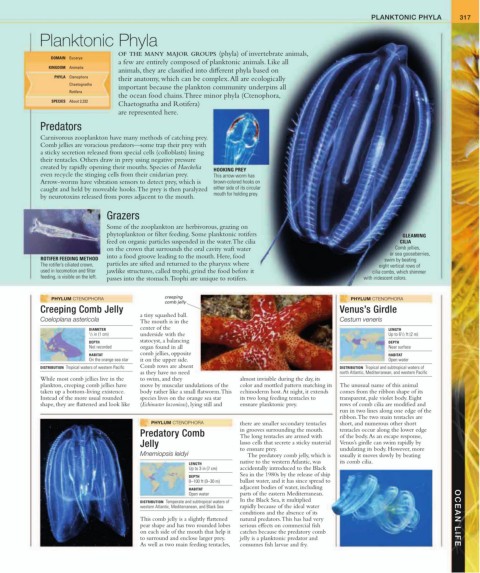
             Planktonic Phyla

                                    OF THE MANY MAJOR GROUPS (phyla) of invertebrate animals,
                DOMAIN  Eucarya
                                    a few are entirely composed of planktonic animals. Like all
               KINGDOM Animalia
                                    animals, they are classified into different phyla based on
                 PHYLA  Ctenophora
                                    their anatomy, which can be complex. All are ecologically
                      Chaetognatha
                                    important because the plankton community underpins all
                      Rotifera
                                    the ocean food chains. Three minor phyla (Ctenophora,
                SPECIES About 2,332
                                    Chaetognatha and Rotifera)
                                    are represented here.
             Predators
             Carnivorous zooplankton have many methods of catching prey.
             Comb jellies are voracious predators—some trap their prey with
             a sticky secretion released from special cells (colloblasts) lining
             their tentacles. Others draw in prey using negative pressure
             created by rapidly opening their mouths. Species of Haeckelia
                                                                 HOOKING PREY
             even recycle the stinging cells from their cnidarian prey.   This arrow-worm has
             Arrow-worms have vibration sensors to detect prey, which is   brown-colored hooks on
             caught and held by moveable hooks. The prey is then paralyzed   either side of its circular
                                                                 mouth for holding prey.
             by neurotoxins released from pores adjacent to the mouth.
                                 Grazers

                                 Some of the zooplankton are herbivorous, grazing on
                                 phytoplankton or filter feeding. Some planktonic rotifers                               GLEAMING
                                 feed on organic particles suspended in the water. The cilia                            CILIA
                                 on the crown that surrounds the oral cavity waft water                                Comb jellies,
                                                                                                                     or sea gooseberries,
                                 into a food groove leading to the mouth. Here, food
             ROTIFER FEEDING METHOD                                                                                 swim by beating
             The rotifer’s ciliated crown,   particles are sifted and returned to the pharynx where               eight vertical rows of
             used in locomotion and filter   jawlike structures, called trophi, grind the food before it         cilia combs, which shimmer
             feeding, is visible on the left.     passes into the stomach. Trophi are unique to rotifers.    with iridescent colors.

                PHYLUM CTENOPHORA                 creeping                                               PHYLUM CTENOPHORA
                                                  comb jelly
             Creeping Comb Jelly                                                                      Venus’s Girdle
                                           a tiny squashed ball.
                                           The mouth is in the
             Coeloplana astericola                                                                    Cestum veneris
                           DIAMETER        center of the                                                             LENGTH
                           1 / 2 in (1 cm)  underside with the                                                       Up to 6 / 2 ft (2 m)
                                                                                                                        1
                           DEPTH           statocyst, a balancing                                                    DEPTH
                           Not recorded    organ found in all                                                        Near surface
                           HABITAT         comb jellies, opposite                                                    HABITAT
                           On the orange sea star  it on the upper side.                                             Open water
             DISTRIBUTION  Tropical waters of western Pacific  Comb rows are absent                    DISTRIBUTION  Tropical and subtropical waters of
                                           as they have no need                                       north Atlantic, Mediterranean, and western Pacific
             While most comb jellies live in the   to swim, and they    almost invisible during the day, its
             plankton, creeping comb jellies have   move by muscular undulations of the   color and mottled pattern matching its  The unusual name of this animal
             taken up a bottom-living existence.   body rather like a small flatworm. This   echinoderm host. At night, it extends   comes from the ribbon shape of its
             Instead of the more usual rounded   species lives on the orange sea star   its two long feeding tentacles to   transparent, pale violet body. Eight
             shape, they are flattened and look like   (Echinaster luzonicus), lying still and   ensnare planktonic prey.  rows of comb cilia are modified and
                                                                                                      run in two lines along one edge of the
                                                                                                      ribbon. The two main tentacles are
                                              PHYLUM CTENOPHORA         there are smaller secondary tentacles   short, and numerous other short
                                           Predatory Comb               in grooves surrounding the mouth.   tentacles occur along the lower edge
                                                                        The long tentacles are armed with
                                                                                                      of the body. As an escape response,
                                           Jelly                        lasso cells that secrete a sticky material   Venus’s girdle can swim rapidly by
                                                                        to ensnare prey.              undulating its body. However, more
                                                                           The predatory comb jelly, which is   usually it moves slowly by beating
                                           Mnemiopsis leidyi
                                                                        native to the western Atlantic, was   its comb cilia.
                                                         LENGTH
                                                         Up to 3 in (7 cm)  accidentally introduced to the Black
                                                                        Sea in the 1980s by the release of ship
                                                         DEPTH
                                                         0–100 ft (0–30 m)  ballast water, and it has since spread to
                                                                        adjacent bodies of water, including
                                                         HABITAT
                                                         Open water     parts of the eastern Mediterranean.
                                                                        In the Black Sea, it multiplied
                                           DISTRIBUTION  Temperate and subtropical waters of
                                           western Atlantic, Mediterranean, and Black Sea  rapidly because of the ideal water
                                                                        conditions and the absence of its
                                           This comb jelly is a slightly flattened   natural predators. This has had very                OCEAN LIFE
                                           pear shape and has two rounded lobes   serious effects on commercial fish
                                           on each side of the mouth that help it   catches because the predatory comb
                                           to surround and enclose larger prey.    jelly is a planktonic predator and
                                           As well as two main feeding tentacles,   consumes fish larvae and fry.

