


Page 314 - (DK) Ocean - The Definitive Visual Guide
P. 314
312


                  CLASS HOLOTHUROIDEA
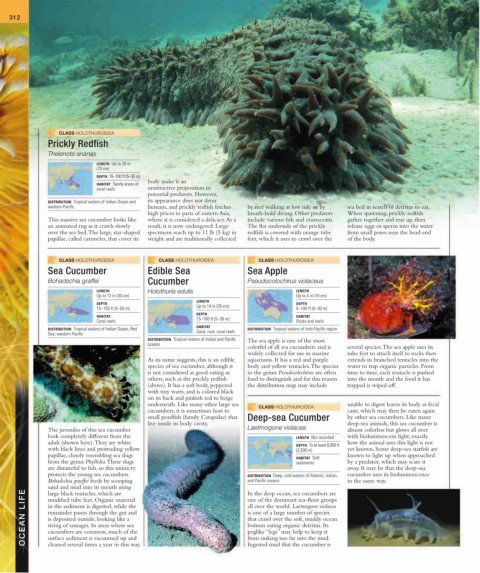
               Prickly Redfish

               Thelenota ananas
                              LENGTH  Up to 28 in
                              (70 cm)
                              DEPTH  16–100 ft (5–30 m)
                                             body make it an
                              HABITAT  Sandy areas of
                              coral reefs    unattractive proposition to
                                             potential predators. However,
               DISTRIBUTION  Tropical waters of Indian Ocean and   its appearance does not deter
               western Pacific                humans, and prickly redfish fetches   by reef walking at low tide or by   sea bed in search of detritus to eat.
                                             high prices in parts of eastern Asia,   breath-hold diving. Other predators   When spawning, prickly redfish
               This massive sea cucumber looks like   where it is considered a delicacy. As a   include various fish and crustaceans.   gather together and rear up, then
               an animated rug as it crawls slowly   result, it is now endangered. Large   The flat underside of the prickly   release eggs or sperm into the water
               over the sea bed. The large, star-shaped   specimens reach up to 11 lb (5 kg) in   redfish is covered with orange tube   from small pores near the head end
               papillae, called caruncles, that cover its   weight and are traditionally collected   feet, which it uses to crawl over the   of the body.


                  CLASS HOLOTHUROIDEA           CLASS HOLOTHUROIDEA           CLASS HOLOTHUROIDEA
               Sea Cucumber                  Edible Sea                    Sea Apple
                                             Cucumber
               Bohadschia graffei                                          Pseudocolochirus violaceus
                              LENGTH                                                     LENGTH
                                             Holothuria edulis
                              Up to 12 in (30 cm)                                        Up to 4 in (10 cm)
                                                           LENGTH
                              DEPTH                                                      DEPTH
                              15–165 ft (5–50 m)           Up to 14 in (35 cm)           0–100 ft (0–30 m)
                                                           DEPTH
                              HABITAT                                                    HABITAT
                              Coral reefs                  15–100 ft (5–30 m)            Rocks and reefs
                                                           HABITAT
               DISTRIBUTION  Tropical waters of Indian Ocean, Red          DISTRIBUTION  Tropical waters of Indo-Pacific region
               Sea, western Pacific                         Sand, rock, coral reefs
                                             DISTRIBUTION  Tropical waters of Indian and Pacific   The sea apple is one of the most
                                             oceans
                                                                           colorful of all sea cucumbers and is   several species. The sea apple uses its
                                                                           widely collected for use in marine   tube feet to attach itself to rocks then
                                             As its name suggests, this is an edible   aquariums. It has a red and purple   extends its branched tentacles into the
                                             species of sea cucumber, although it    body and yellow tentacles. The species   water to trap organic particles. From
                                             is not considered as good eating as   in the genus Pseudocolochirus are often   time to time, each tentacle is pushed
                                             others, such as the prickly redfish   hard to distinguish and for this reason   into the mouth and the food it has
                                             (above). It has a soft body, peppered   the distribution map may include   trapped is wiped off.
                                             with tiny warts, and is colored black
                                             on its back and pinkish red to beige
                                             underneath. Like many other large sea   CLASS HOLOTHUROIDEA  unable to digest leaves its body as fecal
                                             cucumbers, it is sometimes host to                         casts, which may then be eaten again
                                             small pearlfish (family Carapidae) that   Deep-sea Cucumber  by other sea cucumbers. Like many
                                             live inside its body cavity.                               deep-sea animals, this sea cucumber is
               The juveniles of this sea cucumber                          Laetmogone violacea          almost colorless but glows all over
               look completely different from the                                        LENGTH  Not recorded  with bioluminescent light; exactly
               adult (shown here). They are white                                        DEPTH  To at least 8,000 ft   how the animal uses this light is not
               with black lines and protruding yellow                                    (2,500 m)      yet known. Some deep-sea starfish are
               papillae, closely resembling sea slugs                                    HABITAT  Soft    known to light up when approached
               from the genus Phyllidia. These slugs                                     sediments      by a predator, which may scare it
               are distasteful to fish, so this mimicry                                                 away. It may be that the deep-sea
               protects the young sea cucumbers.                           DISTRIBUTION  Deep, cold waters of Atlantic, Indian,   cucumber uses its bioluminescence
               Bohadschia graeffei feeds by scooping                       and Pacific oceans            in the same way.
               sand and mud into its mouth using                           In the deep ocean, sea cucumbers are
        OCEAN LIFE  in the sediment is digested, while the                 all over the world. Laetmogone violacea
               large black tentacles, which are
               modified tube feet. Organic material
                                                                           one of the dominant sea-floor groups
                                                                           is one of a large number of species
               remainder passes through the gut and
               is deposited outside, looking like a
                                                                           that crawl over the soft, muddy ocean
                                                                           bottom eating organic detritus. Its
               string of sausages. In areas where sea
                                                                           peglike “legs” may help to keep it
               cucumbers are common, much of the
               surface sediment is vacuumed up and
                                                                           from sinking too far into the mud.
                                                                           Ingested mud that the cucumber is
               cleaned several times a year in this way.

