


Page 313 - (DK) Ocean - The Definitive Visual Guide
P. 313
311


                CLASS ECHINOIDEA
             Sea Potato

             Echninocardium cordatum
                           LENGTH  Up to
                               1
                           9cm (3 / 2 in)
                           DEPTH  0–200m
                           (0–650ft)
                           HABITAT  Sand, muddy
                           sand
             DISTRIBUTION  Temperate waters of northeastern
             Atlantic

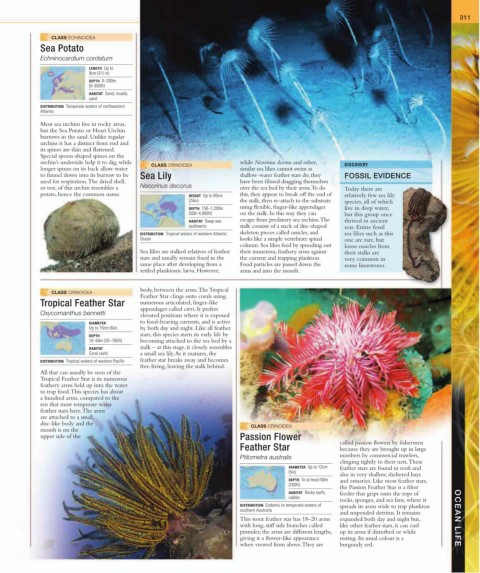
             Most sea urchins live in rocky areas,
             but the Sea Potato or Heart Urchin
             burrows in the sand. Unlike regular
             urchins it has a distinct front end and
             its spines are thin and flattened.
             Special spoon-shaped spines on the
             urchin’s underside help it to dig, while   CLASS CRINOIDEA  while Neocrinus decorus and other,   DISCOVERY
             longer spines on its back allow water                      similar sea lilies cannot swim as
             to funnel down into its burrow to be   Sea Lily            shallow-water feather stars do, they   FOSSIL EVIDENCE
             used for respiration. The dried shell,                     have been filmed dragging themselves
             or test, of this urchin resembles a   Neocrinus decorus    over the sea bed by their arms. To do   Today there are
             potato, hence the common name.              HEIGHT  Up to 60cm   this, they appear to break off the end of   relatively few sea lily
                                                         (24in)         the stalk, then re-attach to the substrate   species, all of which
                                                         DEPTH  150–1,200m   using flexible, finger-like appendages   live in deep water,
                                                         (500–4,000ft)  on the stalk. In this way they can   but this group once
                                                         HABITAT  Deep-sea   escape from predatory sea urchins. The   thrived in ancient
                                                         sediments      stalk consists of a stack of disc-shaped   seas. Entire fossil
                                           DISTRIBUTION  Tropical waters of western Atlantic   skeleton pieces called ossicles, and    sea lilies such as this
                                           Ocean                        looks like a simple vertebrate spinal   one are rare, but
                                                                        column. Sea lilies feed by spreading out   loose ossicles from
                                           Sea lilies are stalked relatives of feather   their numerous, feathery arms against   their stalks are
                                           stars and usually remain fixed in the   the current and trapping plankton.   very common in
                                           same place after developing from a   Food particles are passed down the   some limestones.
                                           settled planktonic larva. However,   arms and into the mouth.


                CLASS CRINOIDEA            body, between the arms. The Tropical
                                           Feather Star clings onto corals using
             Tropical Feather Star         numerous articulated, finger-like
                                           appendages called cirri. It prefers
             Oxycomanthus bennetti         elevated positions where it is exposed
                           DIAMETER        to food-bearing currents, and is active
                           Up to 15cm (6in)  by both day and night. Like all feather
                           DEPTH           stars, this species starts its early life by
                           10–50m (33–165ft)  becoming attached to the sea bed by a
                           HABITAT         stalk – at this stage, it closely resembles
                           Coral reefs     a small sea lily. As it matures, the
             DISTRIBUTION  Tropical waters of western Pacific  feather star breaks away and becomes
                                           free-living, leaving the stalk behind.
             All that can usually be seen of the
             Tropical Feather Star is its numerous
             feathery arms held up into the water
             to trap food. This species has about
             a hundred arms, compared to the
             ten that most temperate water
             feather stars have. The arms
             are attached to a small,
             disc-like body and the                                         CLASS CRINOIDEA
             mouth is on the
             upper side of the                                          Passion Flower
                                                                        Feather Star                  called passion flowers by fishermen
                                                                                                      because they are brought up in large
                                                                                                      numbers by commercial trawlers,
                                                                        Ptilometra australis
                                                                                                      clinging tightly to their nets. These
                                                                                       DIAMETER  Up to 12cm   feather stars are found in reefs and
                                                                                       (5in)
                                                                                                      also in very shallow, sheltered bays
                                                                                       DEPTH  To at least 60m   and estuaries. Like most feather stars,
                                                                                       (200ft)
                                                                                                      the Passion Feather Star is a filter
                                                                                       HABITAT  Rocky reefs,   feeder that grips onto the tops of
                                                                                       rubble
                                                                                                      rocks, sponges, and sea fans, where it
                                                                        DISTRIBUTION  Endemic to temperate waters of   spreads its arms wide to trap plankton
                                                                        southern Australia
                                                                                                      and suspended detritus. It remains
                                                                        This stout feather star has 18–20 arms   expanded both day and night but,    OCEAN LIFE
                                                                        with long, stiff side branches called   like other feather stars, it can curl
                                                                        pinnules; the arms are different lengths,   up its arms if disturbed or while
                                                                        giving it a flower-like appearance   resting. Its usual colour is a
                                                                        when viewed from above. They are   burgundy red.

