


Page 315 - (DK) Ocean - The Definitive Visual Guide
P. 315
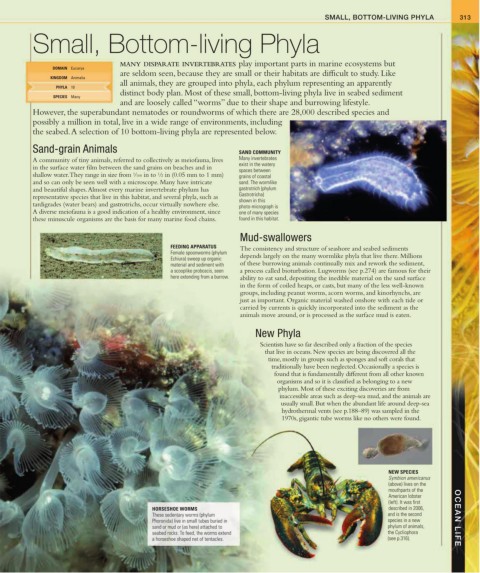
SMALL, BOTTOM-LIVING PHYLA              313


           Small, Bottom-living Phyla


                                     MANY DISPARATE INVERTEBRATES play important parts in marine ecosystems but
                 DOMAIN  Eucarya
                                     are seldom seen, because they are small or their habitats are difficult to study. Like
                KINGDOM Animalia
                                     all animals, they are grouped into phyla, each phylum representing an apparently
                  PHYLA 10
                                     distinct body plan. Most of these small, bottom-living phyla live in seabed sediment
                 SPECIES Many
                                     and are loosely called “worms” due to their shape and burrowing lifestyle.
           However, the superabundant nematodes or roundworms of which there are 28,000 described species and
           possibly a million in total, live in a wide range of environments, including
           the seabed. A selection of 10 bottom-living phyla are represented below.

           Sand-grain Animals                                           SAND COMMUNITY
           A community of tiny animals, referred to collectively as meiofauna, lives   Many invertebrates
           in the surface water film between the sand grains on beaches and in   exist in the watery
                                                                        spaces between
                                                1
                                         1
           shallow water. They range in size from / 100 in to  / 2 in (0.05 mm to 1 mm)   grains of coastal
           and so can only be seen well with a microscope. Many have intricate    sand. The wormlike
           and beautiful shapes. Almost every marine invertebrate phylum has   gastrotrich (phylum
           representative species that live in this habitat, and several phyla, such as   Gastrotricha)
                                                                        shown in this
           tardigrades (water bears) and gastrotrichs, occur virtually nowhere else.    photo-micrograph is
           A diverse meiofauna is a good indication of a healthy environment, since   one of many species
           these minuscule organisms are the basis for many marine food chains.  found in this habitat.
                                                                        Mud-swallowers

                                                    FEEDING APPARATUS   The consistency and structure of seashore and seabed sediments
                                                    Female spoonworms (phylum
                                                    Echiura) sweep up organic   depends largely on the many wormlike phyla that live there. Millions
                                                    material and sediment with    of these burrowing animals continually mix and rework the sediment,
                                                    a scooplike proboscis, seen   a process called bioturbation. Lugworms (see p.274) are famous for their
                                                    here extending from a burrow.   ability to eat sand, depositing the inedible material on the sand surface
                                                                        in the form of coiled heaps, or casts, but many of the less well-known
                                                                        groups, including peanut worms, acorn worms, and kinorhynchs, are
                                                                        just as important. Organic material washed onshore with each tide or
                                                                        carried by currents is quickly incorporated into the sediment as the
                                                                        animals move around, or is processed as the surface mud is eaten.

                                                                             New Phyla

                                                                              Scientists have so far described only a fraction of the species
                                                                                that live in oceans. New species are being discovered all the
                                                                                 time, mostly in groups such as sponges and soft corals that
                                                                                  traditionally have been neglected. Occasionally a species is
                                                                                   found that is fundamentally different from all other known
                                                                                   organisms and so it is classified as belonging to a new
                                                                                    phylum. Most of these exciting discoveries are from
                                                                                    inaccessible areas such as deep-sea mud, and the animals are
                                                                                     usually small. But when the abundant life around deep-sea
                                                                                     hydrothermal vents (see p.188–89) was sampled in the
                                                                                     1970s, gigantic tube worms like no others were found.


                                                                                                                     NEW SPECIES
                                                                                                                     Symbion americanus
                                                                                                                     (above) lives on the
                                                                                                                     mouthparts of the
                                                                                                                     American lobster
                                                                                                                     (left). It was first
                                              HORSESHOE WORMS                                                        described in 2006,
                                              These sedentary worms (phylum                                          and is the second
                                              Phoronida) live in small tubes buried in                               species in a new    OCEAN LIFE
                                              sand or mud or (as here) attached to                                   phylum of animals,
                                              seabed rocks. To feed, the worms extend                                the Cycliophora
                                              a horseshoe shaped net of tentacles.                                   (see p.316).

