


Page 344 - (DK) Ocean - The Definitive Visual Guide
P. 344
342     ANIMAL LIFE


                  ORDER ANGUILLIFORMES          ORDER ANGUILLIFORMES
                                                                            VERSATILE HUNTER
               European Eel                  Chain Moray Eel
                                                                            Most species of moray eels spend   reefs at low tide during the day.
                                                                            the day in holes in a reef with just   It uses its sharp eyesight to search
               Anguilla anguilla             Echidna catenata
                              LENGTH  Up to 4 / 4 ft       LENGTH           their heads sticking out, emerging   for fish and crustaceans in crevices
                                      1
                                                               1
                              (1.3 m)                      Up to 5 / 2 ft (1.7 m)  at dusk to hunt. They rely on their   and holes and, when it has located
                              WEIGHT  14 lb (6.6 kg)       WEIGHT           excellent sense of smell to find fish   its prey, it strikes, rather like a snake.
                                                           Not recorded     resting between corals and rocks.
                              DEPTH  0–2,300 ft                                                         Other moray eels will sometimes
                              (0–700 m)                    DEPTH            Unusually, the chain moray eel    strike at passing prey from their
                                                           0–40 ft (0–12 m)  also hunts over rocky shores and   holes during the day.
               DISTRIBUTION  Temperate waters of northeastern   DISTRIBUTION  Tropical reefs of western and central
               Atlantic, fresh water inland  Atlantic
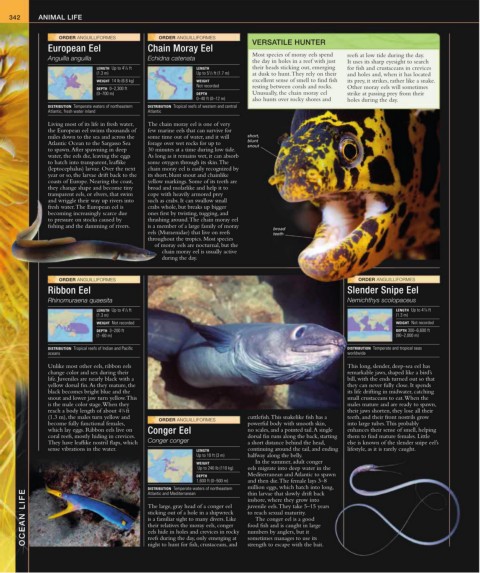
               Living most of its life in fresh water,   The chain moray eel is one of very
               the European eel swims thousands of   few marine eels that can survive for
               miles down to the sea and across the   some time out of water, and it will   short,
               Atlantic Ocean to the Sargasso Sea    forage over wet rocks for up to   blunt
                                                                           snout
               to spawn. After spawning in deep   30 minutes at a time during low tide.
               water, the eels die, leaving the eggs    As long as it remains wet, it can absorb
               to hatch into transparent, leaflike   some oxygen through its skin. The
               (leptocephalus) larvae. Over the next   chain moray eel is easily recognized by
               year or so, the larvae drift back to the   its short, blunt snout and chainlike
               coasts of Europe. Nearing the coast,   yellow markings. Some of its teeth are
               they change shape and become tiny   broad and molarlike and help it to
               transparent eels, or elvers, that swim   cope with heavily armored prey
               and wriggle their way up rivers into   such as crabs. It can swallow small
               fresh water. The European eel is   crabs whole, but breaks up bigger
               becoming increasingly scarce due    ones first by twisting, tugging, and
               to pressure on stocks caused by    thrashing around. The chain moray eel
               fishing and the damming of rivers.  is a member of a large family of moray   broad
                                             eels (Muraenidae) that live on reefs   teeth
                                             throughout the tropics. Most species
                                               of moray eels are nocturnal, but the
                                                 chain moray eel is usually active
                                                 during the day.


                  ORDER ANGUILLIFORMES                                                                      ORDER ANGUILLIFORMES
               Ribbon Eel                                                                               Slender Snipe Eel

               Rhinomuraena quaesita                                                                    Nemichthys scolopaceus
                                                                                                                               1
                              LENGTH  Up to 4 / 4 ft                                                                   LENGTH  Up to 4 / 4 ft
                                      1
                              (1.3 m)                                                                                  (1.3 m)
                              WEIGHT  Not recorded                                                                     WEIGHT  Not recorded
                              DEPTH  3–200 ft                                                                          DEPTH 300–6,600 ft
                              (1–60 m)                                                                                 (90–2,000 m)
               DISTRIBUTION  Tropical reefs of Indian and Pacific                                        DISTRIBUTION  Temperate and tropical seas
               oceans                                                                                   worldwide

               Unlike most other eels, ribbon eels                                                      This long, slender, deep-sea eel has
               change color and sex during their                                                        remarkable jaws, shaped like a bird’s
               life. Juveniles are nearly black with a                                                  bill, with the ends turned out so that
               yellow dorsal fin. As they mature, the                                                   they can never fully close. It spends
               black becomes bright blue and the                                                        its life drifting in midwater, catching
               snout and lower jaw turn yellow. This                                                    small crustaceans to eat. When the
               is the male color stage. When they                                                       males mature and are ready to spawn,
               reach a body length of about 4/4 ft                                                      their jaws shorten, they lose all their
                                     1
               (1.3 m), the males turn yellow and   ORDER ANGUILLIFORMES   cuttlefish. This snakelike fish has a   teeth, and their front nostrils grow
               become fully functional females,                            powerful body with smooth skin,    into large tubes. This probably
               which lay eggs. Ribbon eels live on   Conger Eel            no scales, and a pointed tail. A single   enhances their sense of smell, helping
               coral reefs, mostly hiding in crevices.                     dorsal fin runs along the back, starting   them to find mature females. Little
               They have leaflike nostril flaps, which   Conger conger     a short distance behind the head,   else is known of the slender snipe eel’s
               sense vibrations in the water.              LENGTH          continuing around the tail, and ending   lifestyle, as it is rarely caught.
                                                           Up to 10 ft (3 m)  halfway along the belly.
                                                           WEIGHT            In the summer, adult conger
                                                            Up to 240 lb (110 kg)  eels migrate into deep water in the
                                                           DEPTH           Mediterranean and Atlantic to spawn
                                                           1,600 ft (0–500 m)  and then die. The female lays 3–8
                                             DISTRIBUTION  Temperate waters of northeastern   million eggs, which hatch into long,
        OCEAN LIFE                           The large, gray head of a conger eel   juvenile eels. They take 5–15 years
                                                                           thin larvae that slowly drift back
                                             Atlantic and Mediterranean
                                                                           inshore, where they grow into
                                             sticking out of a hole in a shipwreck
                                                                           to reach sexual maturity.
                                                                             The conger eel is a good
                                             is a familiar sight to many divers. Like
                                             their relatives the moray eels, conger
                                                                           food fish and is caught in large
                                                                           numbers by anglers, but it
                                             eels hide in holes and crevices in rocky
                                             reefs during the day, only emerging at
                                                                           sometimes manages to use its
                                             night to hunt for fish, crustaceans, and
                                                                           strength to escape with the bait.

