


Page 21 - Amphibian
P. 21
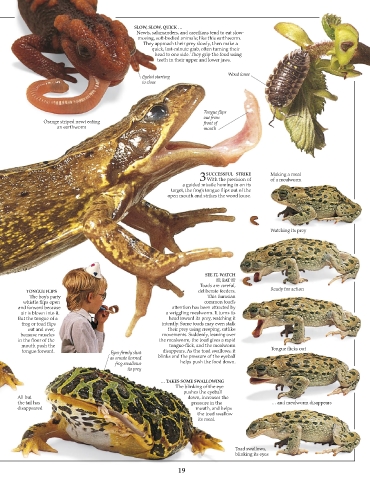
SLOW, SLOW, QUICK …
                                              Newts, salamanders, and caecilians tend to eat slow-
                                               moving, soft-bodied animals; like this earthworm.
                                                They approach their prey slowly, then make a
                                                   quick, last-minute grab, often turning their
                                                    head to one side. They grip the food using
                                                     teeth in their upper and lower jaws.

                                                                             Wood louse
                                                Eyelid starting
                                                to close


                                                                    Tongue flips
                                                                    out from
               Orange striped newt eating                           front of
                    an earthworm                                    mouth


                                                                     SUCCESSFUL  STRIKE    Making a meal
                                                                   3 With the precision of   of a mealworm
                                                             a guided missile homing in on its
                                                          target, the frog’s tongue flips out of the
                                                        open mouth and strikes the wood louse.


                                                                                           Watching its prey


                                                                     SEE IT, WATCH
                                                                         IT, EAT IT
                                                                   Toads are careful,
          TONGUE FLIPS                                             deliberate feeders.     Ready for action
           The boy’s party                                            This Eurasian
         whistle flips open                                          common toad’s
       and forward because                                attention has been attracted by
        air is blown into it.                           a wriggling mealworm. It turns its
       But the tongue of a                               head toward its prey, watching it
        frog or toad flips                             intently. Some toads may even stalk
          out and over,                                  their prey using creeping, catlike
        because muscles                                movements. Suddenly, leaning over
       in the floor of the                            the mealworm, the toad gives a rapid
        mouth push the                                   tongue-flick, and the mealworm
        tongue forward.               Eyes firmly shut   disappears. As the toad swallows, it   Tongue flicks out
                                     as ornate horned   blinks and the pressure of the eyeball
                                       frog swallows         helps push the food down.
                                           its prey
                                                      … TAKES SOME SWALLOWING
                                                           The blinking of the eye
                                                              pushes the eyeball
       All but                                                 down, increases the
       the tail has                                             pressure in the            … and mealworm disappears
       disappeared                                                mouth, and helps
                                                                  the toad swallow
                                                                   its meal.


                                                                               Toad swallows,
                                                                               blinking its eyes

                                                            1

