


Page 22 - Amphibian
P. 22
Hide and seek
            Two green tree frogs


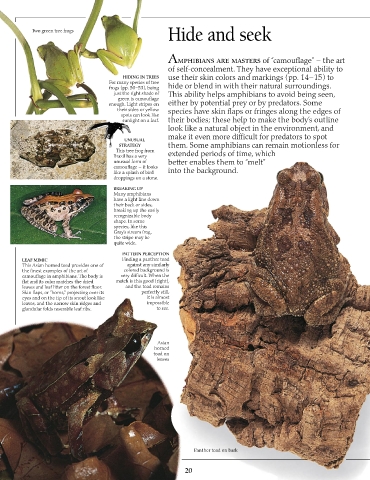
                                                         Amphibians are masters of “camouflage” – the art
                                                         of self-concealment. They have exceptional ability to
                                          HIDING IN TREES  use their skin colors and markings (pp. 14–15) to
                                     For many species of tree
                                     frogs (pp. 50–53), being   hide or blend in with their natural surroundings.
                                       just the right shade of   This ability helps amphibians to avoid being seen,
                                        green is camouflage
                                     enough. Light stripes on   either by potential prey or by predators. Some
                                        their sides or yellow   species have skin flaps or fringes along the edges of
                                         spots can look like
                                          sunlight on a leaf.  their bodies; these help to make the body’s outline
                                                         look like a natural object in the environment, and
                                                         make it even more difficult for predators to spot
                                          UNUSUAL
                                        STRATEGY         them. Some amphibians can remain motionless for
                                       This tree frog from   extended periods of time, which
                                       Brazil has a very
                                       unusual form of   better enables them to “melt”
                                       camouflage – it looks
                                       like a splash of bird   into the background.
                                       droppings on a stone.
                                       BREAKING UP
                                       Many amphibians
                                       have a light line down
                                       their back or sides,
                                       breaking up the easily
                                       recognizable body
                                       shape. In some
                                       species, like this
                                       Gray’s stream frog,
                                       the stripe may be
                                       quite wide.
                                         PATTERN PERCEPTION
        LEAF MIMIC                       Finding a panther toad
        This Asian horned toad provides one of   against any similarly
        the finest examples of the art of   colored background is
        camouflage in amphibians. The body is   very difficult. When the
        flat and its color matches the dried   match is this good (right),
        leaves and leaf litter on the forest floor.   and the toad remains
        Skin flaps, or “horns,” projecting over its   perfectly still,
        eyes and on the tip of its snout look like   it is almost
        leaves, and the narrow skin ridges and    impossible
        glandular folds resemble leaf ribs.          to see.


                                                     Asian
                                                    horned
                                                    toad on
                                                     leaves


                                                                 Panther toad on bark


                                                              20

