


Page 23 - Amphibian
P. 23
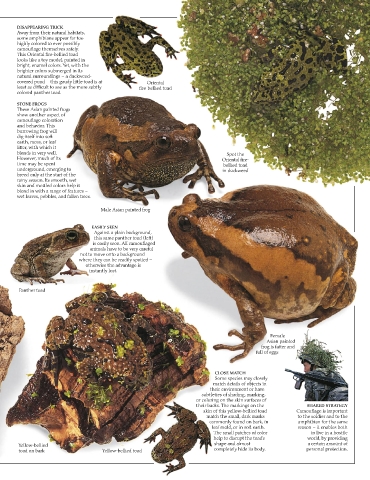
DISAPPEARING TRICK
       Away from their natural habitats,
       some amphibians appear far too
       highly colored to ever possibly
       camouflage themselves safely.
       This Oriental fire-bellied toad
       looks like a toy model, painted in
       bright, enamel colors. Yet, with the
       brighter colors submerged in its
       natural surroundings – a duckweed-
       covered pond – this gaudy little toad is at   Oriental
       least as difficult to see as the more subtly   fire-bellied toad
       colored panther toad.

       STONE FROGS
       These Asian painted frogs
       show another aspect of
       camouflage coloration
       and behavior. This
       burrowing frog will
       dig itself into soft
       earth, moss, or leaf
       litter, with which it
       blends in very well.                                                 Spot the
       However, much of its                                                Oriental fire-
       time may be spent                                                   bellied toad
       underground, emerging to                                            in duckweed
       breed only at the start of the
       rainy season. Its smooth, wet
       skin and mottled colors help it
       blend in with a range of features –
       wet leaves, pebbles, and fallen trees.

                                  Male Asian painted frog

                               EASILY SEEN
                                Against a plain background,
                                this same panther toad (left)
                                is easily seen. All camouflaged
                               animals have to be very careful
                            not to move onto a background
                           where they can be readily spotted –
                             otherwise the advantage is
                               instantly lost.


       Panther toad


                                                                                          Female
                                                                                         Asian painted
                                                                                       frog is fatter and
                                                                                      full of eggs


                                                                        CLOSE MATCH
                                                                        Some species may closely
                                                                        match details of objects in
                                                                       their environment or have
                                                                    subtleties of shading, marking,
                                                                  or coloring on the skin surfaces of
                                                                  their backs. The markings on the     SHARED STRATEGY
                                                                    skin of this yellow-bellied toad   Camouflage is important
                                                                     match the small, dark marks    to the soldier and to the
                                                                      commonly found on bark, in    amphibian for the same
                                                                       leaf mold, or in soft earth.   reason – it enables both
                                                                        The small patches of color      to live in a hostile
                                                                        help to disrupt the toad’s     world, by providing
       Yellow-bellied                                                   shape and almost               a certain amount of
       toad on bark                Yellow-bellied toad                  completely hide its body.     personal protection.

