


Page 24 - Amphibian
P. 24
NO ROAD SENSE
               Every year                           Senses and survival
             thousands of
           amphibians are
         killed on the roads
        during their annual
          migrations to and                         Like other animals, amphibians have five basic senses
               from their                           – touch, taste, sight, hearing, and smell. But they can also
           breeding ponds.
        Road signs like this                        detect ultraviolet and infrared light and the Earth’s
             (right) warn                           magnetic field. Through touch, amphibians can feel
           motorists about
           migrating frogs                          temperature and pain, and respond to irritants, such as
               and toads.
                                                    acids in the environment. As cold-blooded animals with
                                                       porous skin, amphibians need to respond quickly to any
                                                           external changes. In terrestrial (land-based) species,
                                                             a sudden change in temperature can lead to
                                                                  death by drying out or from freezing by rapid
                                                                              chilling. An amphibian’s senses can
                                                                              also help it obtain food, find a mate,
                                                                             and avoid being eaten.


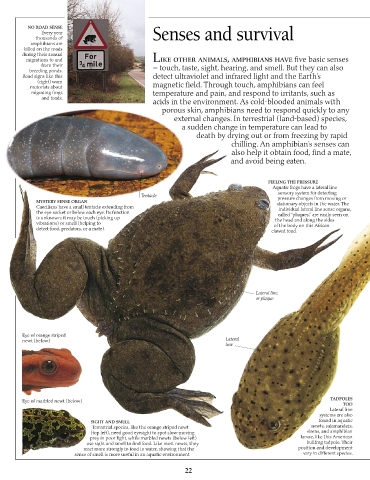
                                                                                          FEELING THE PRESSURE
                                                                                           Aquatic frogs have a lateral line
                                                                                             sensory system for detecting
                                                Tentacle                                     pressure changes from moving or
             MYSTERY SENSE ORGAN                                                             stationary objects in the water. The
             Caecilians have a small tentacle extending from                                 individual lateral line sense organs,
             the eye socket or below each eye. Its function                                  called “plaques,” are easily seen on
             is unknown; it may be touch (picking up                                        the head and along the sides
             vibrations) or smell (helping to                                               of the body on this African
             detect food, predators, or a mate).                                           clawed toad.


                                                                                      Lateral line,
                                                                                      or plaque


        Eye of orange striped
        newt (below)                                                        Lateral
                                                                            line


        Eye of marbled newt (below)                                                                           TADPOLES
                                                                                                                   TOO
                                                                                                              Lateral line
                                                                                                           systems are also
                               SIGHT AND SMELL                                                             found in aquatic
                               Terrestrial species, like the orange striped newt                        newts, salamanders,
                               (top left), need good eyesight to spot slow-moving                      sirens, and amphibian
                               prey in poor light, while marbled newts (below left)                  larvae, like this American
                              use sight and smell to find food. Like most newts, they                 bullfrog tadpole. Their
                             react more strongly to food in water, showing that the                 position and development
                          sense of smell is more useful in an aquatic environment.                   vary in different species.

                                                              22

