


Page 26 - Dinosaur (DK Eyewitness Books)
P. 26
Dinosaur evolution


                                         DȪȯȰȴȢȶȳȴ ȴȦȦȮ ȸȰȯȥȦȳȧȶȭȭȺ ȸȦȪȳȥ and different
                                           from humans, and yet, their skeletons are based on the
                                             same plan as ours. Like us, they had a skull, a backbone, hip
                                              bones, and bones to support their arms and legs. The reason for
                                             these similarities is that both dinosaurs and humans evolved
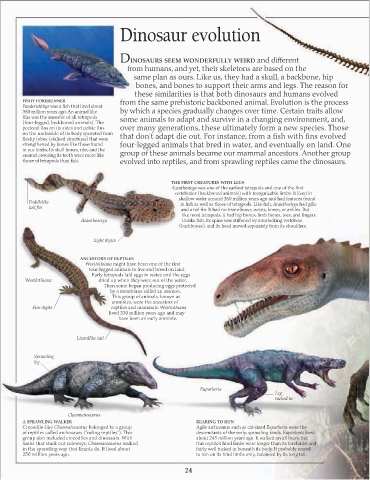
        FISHY FORERUNNER                 from the same prehistoric backboned animal. Evolution is the process
        Panderichthys was a fish that lived about
        380 million years ago. An animal like    by which a species gradually changes over time. Certain traits allow
        this was the ancestor of all tetrapods    some animals to adapt and survive in a changing environment, and,
        (four-legged, backboned animals). The
        pectoral fins on its sides and pelvic fins    over many generations, these ultimately form a new species. Those
        on the underside of its body sprouted from   that don’t adapt die out. For instance, from a fish with fins evolved
        fleshy lobes (stalked structures) that were
        strengthened by bones like those found    four-legged animals that bred in water, and eventually on land. One
        in our limbs. Its skull bones, ribs, and the
        enamel covering its teeth were more like   group of these animals became our mammal ancestors. Another group
        those of tetrapods than fish.    evolved into reptiles, and from sprawling reptiles came the dinosaurs.


                                                          THE FIRST CREATURES WITH LEGS
                                                          Acanthostega was one of the earliest tetrapods and one of the first
                                                           vertebrates (backboned animals) with recognizable limbs. It lived in
                                                            shallow water around 360 million years ago and had features found
           Paddlelike                                        in fish as well as those of tetrapods. Like fish, Acanthostega had gills
           tail fin
                                                             and a tail fin. It had no true elbows, wrists, knees, or ankles. But
                                                             like most tetrapods, it had hip bones, limb bones, toes, and fingers.
                            Acanthostega                     Unlike fish, its spine was stiffened by interlocking vertebrae
                                                            (backbones), and its head moved separately from its shoulders.
                                Eight digits


                           ANCESTORS OF REPTILES
                             Westlothiana might have been one of the first
                              four-legged animals to live and breed on land.
                               Early tetrapods laid eggs in water, and the eggs
         Westlothiana             dried up when they were out of the water.
                                   Then some began producing eggs protected
                                     by a membrane called an amnion.
                                      This group of animals, known as
                                      amniotes, were the ancestors of
            Five digits               reptiles and mammals. Westlothiana
                                     lived 330 million years ago and may
                                        have been an early amniote.


                          Lizardlike tail


            Sprawling
            leg


                                                                   Euparkeria
                                                                                            Leg
                                                                                            tucked in

                       Chasmatosaurus
        A SPRAWLING WALKER                                        REARING TO RUN
        Crocodile-like Chasmatosaurus belonged to a group         Agile archosaurs such as cat-sized Euparkeria were the
        of reptiles called archosaurs (“ruling reptiles”). This   descendants of the early, sprawling kinds. Euparkeria lived
        group also included crocodiles and dinosaurs. With        about 245 million years ago. It walked on all fours, but
        limbs that stuck out sideways, Chasmatosaurus walked      this reptile’s hind limbs were longer than its forelimbs and
         in the sprawling way that lizards do. It lived about     fairly well tucked in beneath its body. It probably reared
         250 million years ago.                                   to run on its hind limbs only, balanced by its long tail.

                                                              24

