


Page 28 - Dinosaur (DK Eyewitness Books)
P. 28
Heads and brains


        A ȥȪȯȰȴȢȶȳpȴ ȩȦȢȥ was built around a skull made up of separate
        bones that slotted together to support the jaws and protect the brain.
        There were holes for eyes, ears, nostrils, and jaw muscles, and often
        extra holes that saved weight. Dinosaur heads came in a variety of
        shapes and sizes. Some skulls were lightly built, with slender
        bones. Other dinosaurs had heavy, solid-looking armored
        skulls. Each skull enclosed a brain that was relatively
        smaller and less complex than the brains of most
        mammals. Some theropods had brains as large as
        those in certain modern birds. These dinosaurs
        may have had very keen senses and could probably
        respond swiftly to their surroundings.


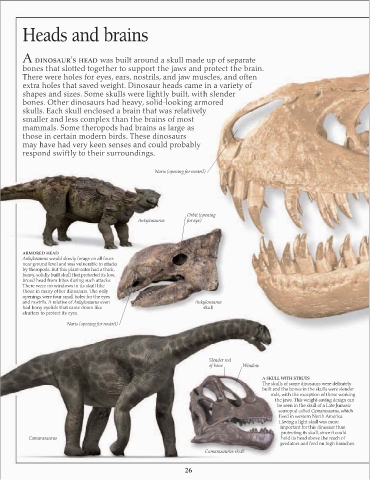
                                                    Naris (opening for nostril)


                                                               Orbit (opening
                                               Ankylosaurus    for eye)


        ARMORED HEAD
        Ankylosaurus would slowly forage on all fours
        near ground level and was vulnerable to attacks
        by theropods. But this plant-eater had a thick,
        heavy, solidly built skull that protected its low,
        broad head from bites during such attacks.
        There were no windows in its skull like
        those in many other dinosaurs. The only
        openings were four small holes for the eyes
        and nostrils. A relative of Ankylosaurus even             Ankylosaurus
        had bony eyelids that came down like                        skull
        shutters to protect its eyes.
                       Naris (opening for nostril)


                                                                      Slender rod
                                                                      of bone    Window

                                                                                        A SKULL WITH STRUTS
                                                                                        The skulls of some dinosaurs were delicately
                                                                                        built and the bones in the skulls were slender
                                                                                           rods, with the exception of those working
                                                                                            the jaws. This weight-saving design can
                                                                                             be seen in the skull of a Late Jurassic
                                                                                             sauropod called Camarasaurus, which
                                                                                             lived in western North America.
                                                                                             Having a light skull was more
                                                                                              important for this dinosaur than
                                                                                              protecting its skull, since it could
          Camarasaurus                                                                        hold its head above the reach of
                                                                                              predators and feed on high branches.
                                                                     Camarasaurus skull

                                                              26

