


Page 42 - Dinosaur (DK Eyewitness Books)
P. 42
All about tails


        DȪȯȰȴȢȶȳȴ ȶȴȦȥ ȵȩȦȪȳ ȵȢȪȭȴ for many different purposes.
        Most importantly, the tails helped the animals to move around.
        Each side of a dinosaur’s tail anchored a muscle that pulled the leg
        on that side backward in order to push the body forward. Because
        a muscle pulls at both ends at once, most theropods’ tails must
        have waggled from side to side as they walked. Tails also helped
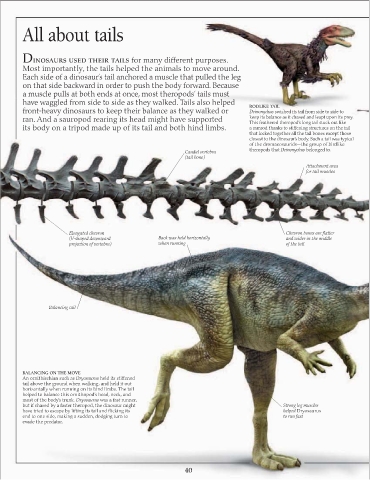
                                                                                    RODLIKE TAIL
        front-heavy dinosaurs to keep their balance as they walked or               Deinonychus swished its tail from side to side to
        ran. And a sauropod rearing its head might have supported                   keep its balance as it chased and leapt upon its prey.
                                                                                    This feathered theropod’s long tail stuck out like
        its body on a tripod made up of its tail and both hind limbs.               a ramrod thanks to stiffening structures on the tail
                                                                                    that locked together all the tail bones except those
                                                                                    closest to the dinosaur’s body. Such a tail was typical
                                                                                    of the dromaeosaurids—the group of birdlike
                                                              Caudal vertebra       theropods that Deinonychus belonged to.
                                                              (tail bone)
                                                                                                      Attachment area
                                                                                                      for tail muscles


                        Elongated chevron                                                       Chevron bones are flatter
                        (V-shaped downward           Back was held horizontally                 and wider in the middle
                        projection of vertebra)      when running                               of the tail


                 Balancing tail


        BALANCING ON THE MOVE
        An ornithischian such as Dryosaurus held its stiffened
        tail above the ground when walking, and held it out
        horizontally when running on its hind limbs. The tail
        helped to balance this ornithopod’s head, neck, and
        most of the body’s trunk. Dryosaurus was a fast runner,
        but if chased by a faster theropod, the dinosaur might                                 Strong leg muscles
        have tried to escape by lifting its tail and flicking its                              helped Dryosaurus
        end to one side, making a sudden, dodging turn to                                      to run fast
        evade the predator.


                                                              40

