


Page 43 - Dinosaur (DK Eyewitness Books)
P. 43
TAILS HELD HIGH
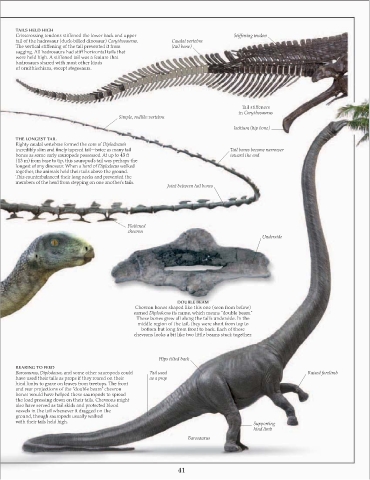
      Crisscrossing tendons stiffened the lower back and upper                Stiffening tendon
      tail of the hadrosaur (duck-billed dinosaur) Corythosaurus.  Caudal vertebra
      The vertical stiffening of the tail prevented it from   (tail bone)
      sagging. All hadrosaurs had stiff horizontal tails that
      were held high. A stiffened tail was a feature that
      hadrosaurs shared with most other kinds
      of ornithischians, except stegosaurs.


                                                                                 Tail stiffeners
                                                                                in Corythosaurus
                                        Simple, rodlike vertebra
                                                                              Ischium (hip bone)
      THE LONGEST TAIL
      Eighty caudal vertebrae formed the core of Diplodocus’s
      incredibly slim and finely tapered tail—twice as many tail             Tail bones become narrower
      bones as some early sauropods possessed. At up to 43 ft                toward the end
      (13 m) from base to tip, this sauropod’s tail was perhaps the
      longest of any dinosaur. When a herd of Diplodocus walked
      together, the animals held their tails above the ground.
      This counterbalanced their long necks and prevented the
      members of the herd from stepping on one another’s tails.
                                                        Joint between tail bones


                                           Flattened
                                           chevron
                                                                                        Underside


                                                            DOUBLE BEAM
                                              Chevron bones shaped like this one (seen from below)
                                             earned Diplodocus its name, which means “double beam.”
                                              These bones grew all along the tail’s underside. In the
                                               middle region of the tail, they were short from top to
                                                bottom but long from front to back. Each of these
                                             chevrons looks a bit like two little beams stuck together.


                                                      Hips tilted back
      REARING TO FEED
      Barosaurus, Diplodocus, and some other sauropods could   Tail used                               Raised forelimb
      have used their tails as props if they reared on their   as a prop
      hind limbs to graze on leaves from treetops. The front
      and rear projections of the “double beam” chevron
      bones would have helped these sauropods to spread
      the load pressing down on their tails. Chevrons might
      also have served as tail skids and protected blood
      vessels in the tail whenever it dragged on the
      ground, though sauropods usually walked
      with their tails held high.
                                                                                     Supporting
                                                                                     hind limb
                                                               Barosaurus


                                                            41

