


Page 44 - Dinosaur (DK Eyewitness Books)
P. 44
Terrifying tails
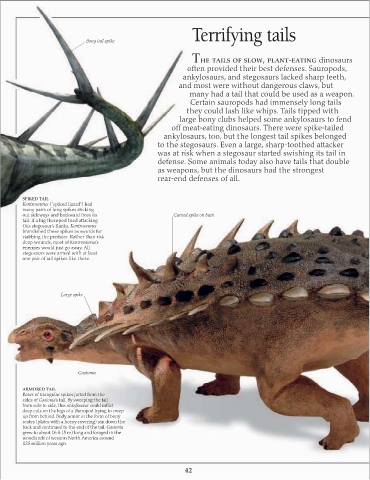
                              Bony tail spike


                                                                 TȩȦ ȵȢȪȭȴ Ȱȧ ȴȭȰȸ  ȱȭȢȯȵ ȦȢȵȪȯȨ dinosaurs
                                                               often provided their best defenses. Sauropods,
                                                              ankylosaurs, and stegosaurs lacked sharp teeth,
                                                            and most were without dangerous claws, but
                                                                many had a tail that could be used as a weapon.
                                                                Certain sauropods had immensely long tails
                                                               they could lash like whips. Tails tipped with
                                                            large bony clubs helped some ankylosaurs to fend
                                                          off meat-eating dinosaurs. There were spike-tailed
                                                       ankylosaurs, too, but the longest tail spikes belonged
                                                     to the stegosaurs. Even a large, sharp-toothed attacker
                                                     was at risk when a stegosaur started swishing its tail in
                                                     defense. Some animals today also have tails that double
                                                     as weapons, but the dinosaurs had the strongest
                                                     rear-end defenses of all.


        SPIKED TAIL
        Kentrosaurus (“spiked lizard”) had
        many pairs of long spikes sticking
        out sideways and backward from its                Curved spike on back
        tail. If a big theropod tried attacking
        this stegosaur’s flanks, Kentrosaurus
        brandished these spikes as swords for
        stabbing the predator. Rather than risk
        deep wounds, most of Kentrosaurus’s
        enemies would just go away. All
        stegosaurs were armed with at least
        one pair of tail spikes like these.


                     Large spike


                           Gastonia


        ARMORED TAIL
        Rows of triangular spikes jutted from the
        sides of Gastonia’s tail. By sweeping the tail
        from side to side, this ankylosaur could inflict
        deep cuts on the legs of a theropod trying to creep
        up from behind. Body armor in the form of bony
        scutes (plates with a horny covering) ran down the
        back and continued to the end of the tail. Gastonia
        grew to about 16 ft (5 m) long and foraged in the
        woodlands of western North America around
        125 million years ago.


                                                              42

