


Page 30 - Complete Birds of Britain and Europe (DK - RSPB)
P. 30
INTRODUCTION

        WESTERN PALEARCTIC

          urope, North Africa, and Asia (north of the
        EHimalayas) form one large entity, called the
        Palearctic. It is identified by a characteristic set of
        plants and animals, which adhere to natural rather
        than political boundaries.This book focuses on
        the western part of this region – west of the Ural
        Mountains – giving an overview of the birdlife in
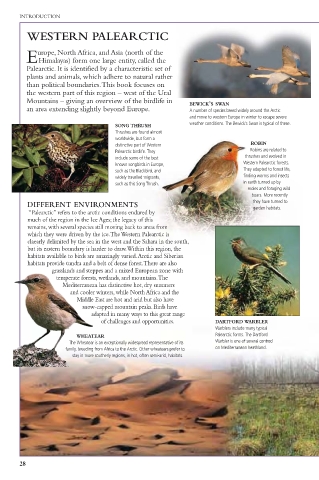
                                                BEWICK’SSWAN
        an area extending slightly beyond Europe.  A number of species breed widely around the Arctic
                                                and move to western Europe in winter to escape severe
                                                weather conditions. The Bewick’s Swan is typical of these.
                              SONG THRUSH
                              Thrushes are found almost
                              worldwide, but form a
                              distinctive part of Western      ROBIN
                              Palearctic birdlife. They        Robins are related to
                              include some of the best        thrushes and evolved in
                              known songbirds in Europe,     Western Palearctic forests.
                              such as the Blackbird, and     They adapted to forest life,
                              widely travelled migrants,     finding worms and insects
                              such as this Song Thrush.      in earth turned up by
                                                               moles and foraging wild
                                                                boars. More recently
                                                                they have turned to
        DIFFERENT ENVIRONMENTS                                  garden habitats.
        “Palearctic” refers to the arctic conditions endured by
        much of the region in the Ice Ages; the legacy of this
        remains, with several species still moving back to areas from
        which they were driven by the ice.The Western Palearctic is
        claearly delimited by the sea in the west and the Sahara in the south,
        but its eastern boundary is harder to draw.Within this region, the
        habitats available to birds are amazingly varied.Arctic and Siberian
        habitats provide tundra and a belt of dense forest.There are also
              grasslands and steppes and a mixed European zone with
               temperate forests, wetlands, and mountains.The
                 Mediterranean has distinctive hot, dry summers
                  and cooler winters,while North Africa and the
                    Middle East are hot and arid but also have
                      snow-capped mountain peaks.Birds have
                        adapted in many ways to this great range
                          of challenges and opportunities.  DARTFORD WARBLER
                                                      Warblers include many typical
                    WHEATEAR                          Palearctic forms. The Dartford
                  The Wheatear is an exceptionally widespread representative of its  Warbler is one of several centred
                 family, breeding from Africa to the Arctic. Other wheatears prefer to  on Mediterranean heathland.
                   stay in more southerly regions, in hot, often semi-arid, habitats.


      28

