


Page 164 - Applied Statistics with R
P. 164
164                   CHAPTER 9. MULTIPLE LINEAR REGRESSION


                                                              ̂
                                                                        ̂
                                                                −           − 0


                                                            =       =        ,
                                                                  ̂
                                                             SE[   ]     √


                                 which, under the null hypothesis, follows a    distribution with    −    degrees of
                                 freedom.
                                 Recall our model for mpg,
                                                  =    +       +       +    ,     = 1, 2, … ,

                                                                2   2
                                                     0
                                                         1   1

                                                 2
                                 where    ∼   (0,    ).

                                    •      1  as the weight (wt) of the   th car.
                                    •      2  as the model year (year) of the   th car.
                                 Then the test

                                                          ∶    = 0  vs    ∶    ≠ 0
                                                            1
                                                        0
                                                                            1
                                                                        1
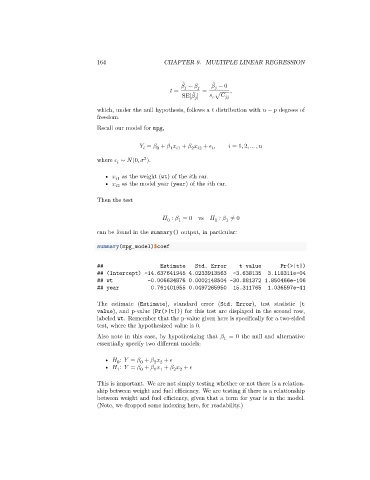
                                 can be found in the summary() output, in particular:
                                 summary(mpg_model)$coef


                                 ##                   Estimate    Std. Error    t value       Pr(>|t|)
                                 ## (Intercept) -14.637641945 4.0233913563    -3.638135   3.118311e-04
                                 ## wt            -0.006634876 0.0002148504 -30.881372 1.850466e-106
                                 ## year           0.761401955 0.0497265950   15.311765   1.036597e-41

                                 The estimate (Estimate), standard error (Std. Error), test statistic (t
                                 value), and p-value (Pr(>|t|)) for this test are displayed in the second row,
                                 labeled wt. Remember that the p-value given here is specifically for a two-sided
                                 test, where the hypothesized value is 0.

                                 Also note in this case, by hypothesizing that    = 0 the null and alternative
                                                                           1
                                 essentially specify two different models:

                                    •    :    =    +       +
                                        0
                                                    2 2
                                               0
                                    •    :    =    +       +       +
                                               0
                                        1
                                                          2 2
                                                    1 1
                                 This is important. We are not simply testing whether or not there is a relation-
                                 ship between weight and fuel efficiency. We are testing if there is a relationship
                                 between weight and fuel efficiency, given that a term for year is in the model.
                                 (Note, we dropped some indexing here, for readability.)

