


Page 166 - Applied Statistics with R
P. 166
166                   CHAPTER 9. MULTIPLE LINEAR REGRESSION


                                                        ⊤ ̂
                                                ̂   (   ) =
                                                  0
                                                        0
                                                        ̂
                                                                               ̂
                                                                    ̂
                                                            ̂

                                                    =    +        +        + ⋯ +      −1 0(  −1) .
                                                        0
                                                                   2 02
                                                            1 01
                                 As with SLR, this is an unbiased estimate.
                                                         ⊤

                                              E[ ̂(   )] =
                                                   0
                                                         0

                                                      =    +        +        + ⋯ +      −1 0(  −1)
                                                         0
                                                              1 01
                                                                     2 02
                                 To make an interval estimate, we will also need its standard error.
                                                      SE[ ̂(   )] =       √ ⊤  ⊤  −1     0
                                                                       (     )

                                                            0
                                                                     0
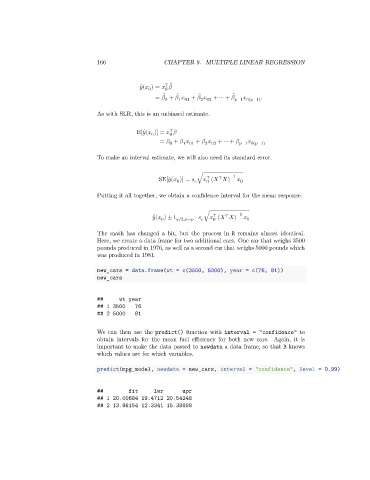
                                 Putting it all together, we obtain a confidence interval for the mean response.
                                                     ̂   (   ) ±      /2,  −    ⋅       √ ⊤  ⊤  −1     0
                                                                         (     )
                                                      0
                                                                        0
                                 The math has changed a bit, but the process in R remains almost identical.
                                 Here, we create a data frame for two additional cars. One car that weighs 3500
                                 pounds produced in 1976, as well as a second car that weighs 5000 pounds which
                                 was produced in 1981.
                                 new_cars = data.frame(wt = c(3500, 5000), year = c(76, 81))
                                 new_cars


                                 ##     wt year
                                 ## 1 3500    76
                                 ## 2 5000    81


                                 We can then use the predict() function with interval = "confidence" to
                                 obtain intervals for the mean fuel efficiency for both new cars. Again, it is
                                 important to make the data passed to newdata a data frame, so that R knows
                                 which values are for which variables.


                                 predict(mpg_model, newdata = new_cars, interval = "confidence", level = 0.99)


                                 ##         fit     lwr      upr
                                 ## 1 20.00684 19.4712 20.54248
                                 ## 2 13.86154 12.3341 15.38898

