Page 185 - First Aid for the USMLE Step 1 2020, Thirtieth edition [MedicalBooksVN.com]_Neat
P. 185
Microbiology  ` microbiology—cliNical bacteriology  Microbiology  ` microbiology—cliNical bacteriology  SEcTioN ii     141


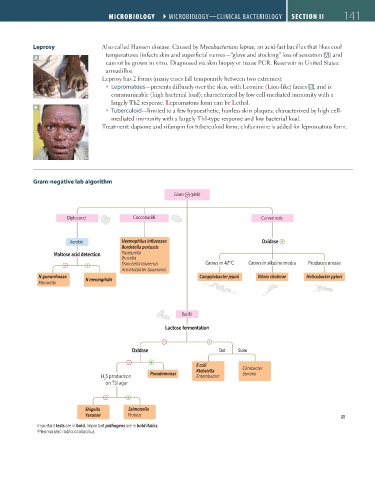
                  Leprosy                Also called Hansen disease. Caused by Mycobacterium leprae, an acid-fast bacillus that likes cool
                                          temperatures (infects skin and superficial nerves—“glove and stocking” loss of sensation  A ) and
                   A
                                          cannot be grown in vitro. Diagnosed via skin biopsy or tissue PCR. Reservoir in United States:
                                          armadillos.
                                         Leprosy has 2 forms (many cases fall temporarily between two extremes):
                                             ƒ Lepromatous—presents diffusely over the skin, with Leonine (Lion-like) facies  B , and is
                                            communicable (high bacterial load); characterized by low cell-mediated immunity with a
                                            largely Th2 response. Lepromatous form can be Lethal.
                   B
                                             ƒ Tuberculoid—limited to a few hypoesthetic, hairless skin plaques; characterized by high cell-
                                            mediated immunity with a largely Th1-type response and low bacterial load.
                                         Treatment: dapsone and rifampin for tuberculoid form; clofazimine is added for lepromatous form.


                  Gram-negative lab algorithm

                                                                Gram       (pink)


                              Diplococci           Coccobacilli                              Curved rods


                              Aerobic          Haemophilus influenzae                         Oxidase
                                               Bordetella pertussis
                         Maltose acid detection  Pasteurella
                                               Brucella
                                               Francisella tularensis      Grows in 42°C  Grows in alkaline media  Produces urease
                                               Acinetobacter baumannii
                    N gonorrhoeae   N meningitidis                       Campylobacter jejuni  Vibrio cholerae  Helicobacter pylori
                    Moraxella


                                                                   Bacilli
                                                              Lactose fermentation


                                                   Oxidase                     Fast  Slow

                                                                        E coli
                                                                        Klebsiella     Citrobacter
                                                         Pseudomonas                   Serratia
                                         H S production                 Enterobacter
                                          2
                                          on TSI agar


                                   Shigella      Salmonella
                                   Yersinia a    Proteus
                    Important tests are in bold. Important pathogens are in bold italics.
                    a Pleomorphic rod/coccobacillus


          FAS1_2019_03-Microbiology.indd   141                                                                         11/14/19   12:20 PM
   180   181   182   183   184   185   186   187   188   189   190