


Page 689 - First Aid for the USMLE Step 1 2020, Thirtieth edition [MedicalBooksVN.com]_Neat
P. 689
RepRoductive ` REPRODUCTIVE—PATHOlOgy RepRoductive ` REPRODUCTIVE—PATHOlOgy SectioN iii 645
Cervical pathology
Dysplasia and Disordered epithelial growth; begins at basal layer of squamocolumnar junction (transformation
carcinoma in situ zone) and extends outward. Classified as CIN 1, CIN 2, or CIN 3 (severe, irreversible dysplasia or
carcinoma in situ), depending on extent of dysplasia. Associated with HPV-16 and HPV-18, which
A
produce both the E6 gene product (inhibits TP53) and E7 gene product (inhibits pRb) (6 before 7;
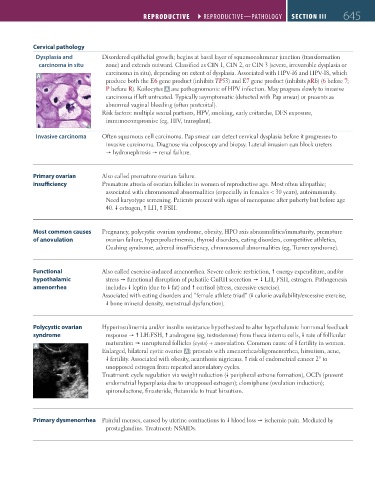
P before R). Koilocytes A are pathognomonic of HPV infection. May progress slowly to invasive
carcinoma if left untreated. Typically asymptomatic (detected with Pap smear) or presents as
abnormal vaginal bleeding (often postcoital).
Risk factors: multiple sexual partners, HPV, smoking, early coitarche, DES exposure,
immunocompromise (eg, HIV, transplant).
Invasive carcinoma Often squamous cell carcinoma. Pap smear can detect cervical dysplasia before it progresses to
invasive carcinoma. Diagnose via colposcopy and biopsy. Lateral invasion can block ureters
hydronephrosis renal failure.
Primary ovarian Also called premature ovarian failure.
insufficiency Premature atresia of ovarian follicles in women of reproductive age. Most often idiopathic;
associated with chromosomal abnormalities (especially in females < 30 years), autoimmunity.
Need karyotype screening. Patients present with signs of menopause after puberty but before age
40. estrogen, LH, FSH.
Most common causes Pregnancy, polycystic ovarian syndrome, obesity, HPO axis abnormalities/immaturity, premature
of anovulation ovarian failure, hyperprolactinemia, thyroid disorders, eating disorders, competitive athletics,
Cushing syndrome, adrenal insufficiency, chromosomal abnormalities (eg, Turner syndrome).
Functional Also called exercise-induced amenorrhea. Severe caloric restriction, energy expenditure, and/or
hypothalamic stress functional disruption of pulsatile GnRH secretion LH, FSH, estrogen. Pathogenesis
amenorrhea includes leptin (due to fat) and cortisol (stress, excessive exercise).
Associated with eating disorders and “female athlete triad” ( calorie availability/excessive exercise,
bone mineral density, menstrual dysfunction).
Polycystic ovarian Hyperinsulinemia and/or insulin resistance hypothesized to alter hypothalamic hormonal feedback
syndrome response LH:FSH, androgens (eg, testosterone) from theca interna cells, rate of follicular
A maturation unruptured follicles (cysts) + anovulation. Common cause of fertility in women.
Enlarged, bilateral cystic ovaries A ; presents with amenorrhea/oligomenorrhea, hirsutism, acne,
fertility. Associated with obesity, acanthosis nigricans. risk of endometrial cancer 2° to
unopposed estrogen from repeated anovulatory cycles.
Treatment: cycle regulation via weight reduction ( peripheral estrone formation), OCPs (prevent
endometrial hyperplasia due to unopposed estrogen); clomiphene (ovulation induction);
spironolactone, finasteride, flutamide to treat hirsutism.
Primary dysmenorrhea Painful menses, caused by uterine contractions to blood loss ischemic pain. Mediated by
prostaglandins. Treatment: NSAIDs.
FAS1_2019_15-Repro.indd 645 11/7/19 5:52 PM

