


Page 690 - First Aid for the USMLE Step 1 2020, Thirtieth edition [MedicalBooksVN.com]_Neat
P. 690
646 SectioN iii RepRoductive ` REPRODUCTIVE—PATHOlOgy RepRoductive ` REPRODUCTIVE—PATHOlOgy
Ovarian cysts
Follicular cyst Distention of unruptured Graafian follicle. May be associated with hyperestrogenism, endometrial
hyperplasia. Most common ovarian mass in young women.
Theca-lutein cyst Often bilateral/multiple. Due to gonadotropin stimulation. Associated with choriocarcinoma and
hydatidiform moles.
Ovarian neoplasms Most common adnexal mass in women >55 years old. Present with abdominal distention, bowel
obstruction, pleural effusion.
Risk with advanced age, infertility, endometriosis, PCOS, genetic predisposition (eg, BRCA1 or
BRCA2 mutations, Lynch syndrome, strong family history).
Risk with previous pregnancy, history of breastfeeding, OCPs, tubal ligation.
Epithelial tumors are typically serous (lined by serous epithelium natively found in fallopian tubes,
and often bilateral) or mucinous (lined by mucinous epithelium natively found in cervix). Monitor
response to therapy/relapse by measuring CA 125 levels (not good for screening).
Germ cell tumors can differentiate into somatic structures (eg, teratomas), or extra-embryonic
structures (eg, yolk sac tumors), or can remain undifferentiated (eg, dysgerminoma).
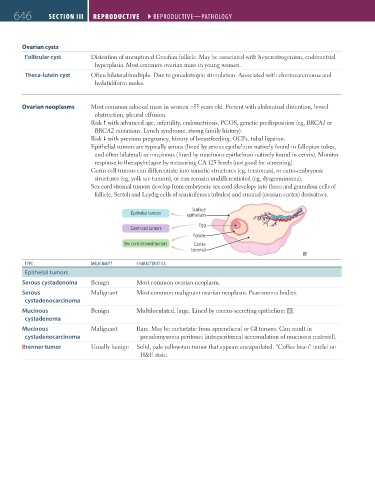
Sex cord stromal tumors develop from embryonic sex cord (develops into theca and granulosa cells of
follicle, Sertoli and Leydig cells of seminiferous tubules) and stromal (ovarian cortex) derivatives.
Surface
Epithelial tumors epithelium
Egg
Germ cell tumors
Follicle
Sex cord stromal tumors Cortex
(stroma)
TyPE mAlIgNANT? CHARACTERISTICS
Epithelial tumors
Serous cystadenoma Benign Most common ovarian neoplasm.
Serous Malignant Most common malignant ovarian neoplasm. Psammoma bodies.
cystadenocarcinoma
Mucinous Benign Multiloculated, large. Lined by mucus-secreting epithelium A .
cystadenoma
Mucinous Malignant Rare. May be metastatic from appendiceal or GI tumors. Can result in
cystadenocarcinoma pseudomyxoma peritonei (intraperitoneal accumulation of mucinous material).
Brenner tumor Usually benign Solid, pale yellow-tan tumor that appears encapsulated. “Coffee bean” nuclei on
H&E stain.
FAS1_2019_15-Repro.indd 646 11/7/19 5:52 PM

