


Page 726 - First Aid for the USMLE Step 1 2020, Thirtieth edition [MedicalBooksVN.com]_Neat
P. 726
682 seCtioN iii RespiRatoRy ` RESPIRATORY—PAThOlOgY RespiRatoRy ` RESPIRATORY—PAThOlOgY
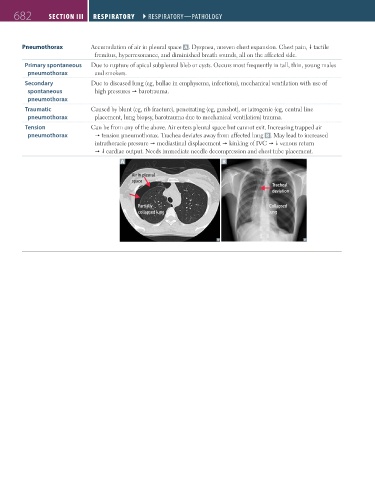
Pneumothorax Accumulation of air in pleural space A . Dyspnea, uneven chest expansion. Chest pain, tactile
fremitus, hyperresonance, and diminished breath sounds, all on the affected side.
Primary spontaneous Due to rupture of apical subpleural bleb or cysts. Occurs most frequently in tall, thin, young males
pneumothorax and smokers.
Secondary Due to diseased lung (eg, bullae in emphysema, infections), mechanical ventilation with use of
spontaneous high pressures barotrauma.
pneumothorax
Traumatic Caused by blunt (eg, rib fracture), penetrating (eg, gunshot), or iatrogenic (eg, central line
pneumothorax placement, lung biopsy, barotrauma due to mechanical ventilation) trauma.
Tension Can be from any of the above. Air enters pleural space but cannot exit. Increasing trapped air
pneumothorax tension pneumothorax. Trachea deviates away from affected lung B . May lead to increased
intrathoracic pressure mediastinal displacement kinking of IVC venous return
cardiac output. Needs immediate needle decompression and chest tube placement.
A B
Air in pleural
space
Tracheal
deviation
Partially Collapsed
collapsed lung lung
FAS1_2019_16-Respiratory.indd 682 11/8/19 7:34 AM

