


Page 463 - APPLIED PROCESS DESIGN FOR CHEMICAL AND PETROCHEMICAL PLANTS, Volume 1, 3rd Edition
P. 463
Process Safety and Pressure-Relieving Devices                       429

                     Solely Valve                                  Vacuum:  (a)  Removal  of liquid or vapor at greater rate
                       SV-1  +
             High   fl   .$-•  I           Block                than entering a vessel, capacity determined by volume dis-
          Pressure�                        Vo Ive               placed.  (b)  Injecting  cold liquid  into  hot  (steamed  out)
                                              t
            Steam   Reducing   I  I             Driven  Equipment
                  Station                 • --  (Ctntrifugal  Camprmor  I   vessel, the condensing steam will create vacuum, and must
                                                Pump,  etc.)
                                Sleom  Turbine                  be  relieved.  Capacity  is equivalent to vapor condensed.
                                  Driver
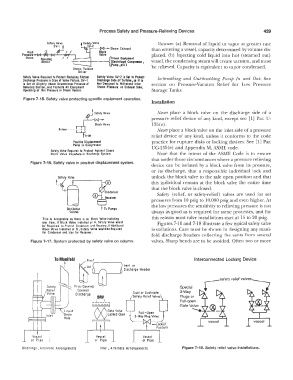
           Safely  Valve  Required  lo  Protect Reducing  Slotion   Solely  Valve  SV-2  is  Set to  Protect   In-breathing  and  Out-breathing  Pum,1J  In  and  Out:  See
           Discharge  Pressure in Cose of Valve  Failure. SV-1   Discharge  Side  of Turbine,  as  ii is
           is  Set  at Slightly  Above  Downstream  Pressure of   Not Designed  lo  Withstand  Inlet   section  on  Pressure-Vacuum  Relief  for  Low  Pressure
           Reducing  Station,  ond  Protects  All  Equipment   Steam  Pressure  on  Exhaust  Side.
           Operating  ot  this  Pressure on  Sleom  Header.     Storage Tanks.
           Figure 7-15.  Safety valve protecting specific equipment operation.
                                                                Installation
                                                                   Never  place  a  block valve  on  the  discharge  side  of a
                                                                pressure  relief device  of any kind,  except see  [I]  Par.  U-
                                                                 135(e).
                                                                   Never place a block valve on the inlet side of a  pressure
                                                                relief device  of any  kind,  unless  it conforms  to  the  code
                                Positive D isplacemenl          practice for rupture disks  or locking devices.  See  [1] Par.
                                Pump  or Compressor
                                                                UG-135(e)  and Appendix M, ASME code.
                      Sotery  Valve  Required  to  Protect Against Closed
                      B!ock  Vo Ive  Anywhere  in  Discharge  Sys fem.   Note  that  the  intent of the  ASME  Code  is  to  ensure
                                                                that under those circumstances where a pressure relieving
              Figure 7-16.  Safety valve in positive displacement system.
                                                                device  can be  isolated by a  block valve  from its  pressure,
                                                                or  its  discharge,  that a  responsible  individual  lock  and
                                                                unlock  the block valve to  the safe  open  position and that
                                                                this  individual  remain  at the  block valve  the  entire  time
                                                                that the block valve  is closed.
                                                                   Safety  (relief,  or  safety-relief)  valves  are  used  for  set
                                                                pressures from  10 psig to  10,000 psig and even higher.  At
                                                                the low pressures the sensitivity to relieving pressure is not
                             Oistillotion
                              Column                            always  as  good  as  is required for some processes,  and for
                   This  is  Accepfoble  os  there  is  r.o  Block  Valve  Isolating   this reason most valve installations start at 15 to  20 psig.
                   ony  Item. II Block  Vo Ive  Installed  ot  A, Sofery  Valve  would   Figures 7-10 and 7-18 illustrate a few typical safety valve
                   be  RE quired  to  Protect  Condenser  and  Receiver. II Additional
                   Bloc•  Valve  Installed ot  B,  Safety  Valve  would  be Required   installations.  Care  must be  shown  in designing any mani-
                   for  Condenser  ond  also  for  Receiver.
                                                                fold  discharge  headers  collecting  rhe vents  from  several
              Figure 7-17. System protected by safety valve on  column.   valves.  Sharp bends are to be avoided.  Often two or more


                          b       w         !        Vent  or
                        To Manifold   1;0 �                           1           interconnected  Locking Device
                                  r<:,
                                                     Dischcrqe  Hecder


                                Free-Opening
                                 Covered                                    Special
                                                                            3-Way
                                 Discharge
                                                                            Plugs or
                                                                            Full-open
                                                                                 --...
                                                                            Gate Valve
                            Liquid
                            Drain
                            Hole
                                                                                                           vessel
               Vessel                                        Vessel
              or  Pipe                                       or  Pipe
          Dischorqe  ,  A:tcrr.ote  Arrongemer.ls   Inlet,  Alternate  Arrangements   Figure 7-18.  Safety relief valve installations.

