


Page 13 - Tomb of Annihilation
P. 13
CHULTANS
                                                             fined metal ore, and other commodities plucked and
           Chultans are the human natives of Chult. They have   plundered from the jungles, valleys, and mountains of
           dark  skin, black hair, and a rich culture. Driven out of   Chult. Among themselves, all Chultans still speak their
           the jungle by monsters and undead, they took refuge   own tribal languages (a mix of  exhaled and inhaled vow-
           behind the stout walls of Port Nyanzaru, gave up their   els, consonants, and tongue clicks), but any who deaJ
           dynasties, and united to become a mercantile power in   regularly with foreigners also speak Common fluently,
           the southern ocean, eager to do business with anyone   often with a heavy, characteristic accent.
           who visits their perilous land. A few Chultans migrated   Chultans in Port Nyan. zaru seldom don armor because
           northward and established outposts in distant cities   of the climate, but large, colorful shields made from
           such as Athkatla, Baldur's Gate, Calimport, Memnon,   toughened dinosaur hide are ubiquitous. These shields
           and Zazesspur.                                    are called hlang and function as ordinary shields. In
             The lines of kings and queens that once held political   melee, they favor the traditional yklwa (pronounced
           sway throughout Chult have been mostly wiped out   YICK-ul-wah), a short, broad-bladed, one-handed, spear-
           by time, war, calamity, and misfortune. They've been   like weapon. For more information about the yklwa, see
           replaced by Chultan merchant princes who learned the   "Buying a Special Item," page 31.
           art and craft of trading from Amnian and Tethyrian prof-
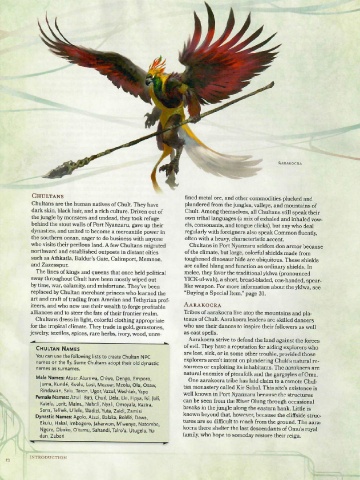
           iteers, and who now use their wealth to forge profitable   AARAKOCRA
           alliances and to steer the fate of their frontier realm.   Tribes of  aarakocra live atop the mountains and pla-
             Chultans dress in light, colorful clothing appropriate   teaus of Chult. Aarakocra leaders are skilled dancers
           for the tropical climate. They trade in gold, gemstones,   who use their dances to inspire their followers as well
           jewelry, textiles, spices, rare herbs, ivory, wood, unre-  as cast spells.
                                                              Aarakocra strive to defend the land against the forces
                                                             of evil. They have a reputation for aiding explorers who
             (HULTAN  NAM ES
                                                             are lost, sick, or in some other trouble, provided those
             You can use the following lists to create Chultan NPC
                                                             explorers aren't intent on plundering Chult's natural re-
             names on the Ay. Some Chultans adopt their old dynastic
             names as surnames.                              sources or exploiting its inhabitants. The aarakocra are
                                                             natural enemies of pterafolk and the gargoyles of  Omu.
             M ale Names: Atuar, Atumwa, Chiwa,  Dengo,  Emporo,
                                                              One aarakocra tribe ha$ laid claim to a remote Chul-
              Juma, Kunde, Kwalu, Losi, Mezoar, Mzolu, Olu, Osaw,
                                                             tan monastery called Kir Sabal. This site's existence is
              Rindawan, Selu,  Teron, Ugor, Vazul, Weshtek, Yapa
                                                             well known in Port Nyanzaru because the structures
             F emale Names: Azuil.  Bati, Chuil, Dela, Eki, Fipya,  lsi, Joli,
                                                             can be seen from the River Olung through occasional
              Katela, Lorit,  Mainu, Naboli, Nyali, Omoyala, Razira,
                                                             breaks in the jungle along the eastern bank. Little is
              Sana, T efnek, U'lolo, Wadizi, Yuta, Zaidi, Zamisi
                                                             known beyond that, however, because the cliffside struc-
             Dynastic Names: Agolo, Atazi,  Balaka, Bolele, Dawa,
              Ekulu,  Hakal, lmbogoro, jaharwon, M'wenye, Natombe,   tures are so difficult to reach from the ground. The aara-
                                                             kocra there shelter the last descendants of Omu's royal
              Ngore, Oboko, O'tamu, Sahandl, Talro'a, Utugelu, Yu·
              dan, Zuberi                                    family, who hope to someday restore their reign.
           INTRODUCTION
   12

