


Page 164 - Python Data Science Handbook
P. 164
3  NaN  B3  C3
                                                      4  NaN  B4  C4
               The combination of options of the pd.concat function allows a wide range of possi‐
               ble behaviors when you are joining two datasets; keep these in mind as you use these
               tools for your own data.

               The append() method

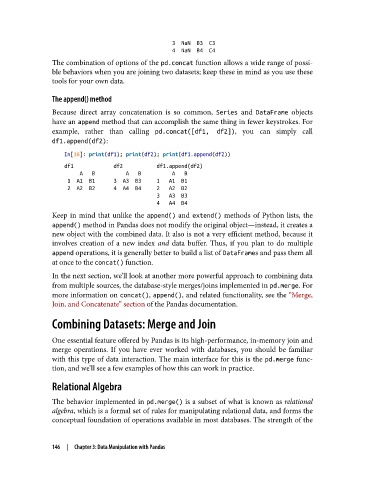
               Because direct array concatenation is so common, Series  and DataFrame  objects
               have an append method that can accomplish the same thing in fewer keystrokes. For
               example, rather than calling pd.concat([df1,  df2]), you can simply call
               df1.append(df2):

                   In[16]: print(df1); print(df2); print(df1.append(df2))
                   df1             df2           df1.append(df2)
                        A   B          A   B          A   B
                    1  A1  B1      3  A3  B3     1   A1  B1
                    2  A2  B2      4  A4  B4     2   A2  B2
                                                 3   A3  B3
                                                 4   A4  B4
               Keep in mind that unlike the append()  and extend()  methods of Python lists, the
               append() method in Pandas does not modify the original object—instead, it creates a
               new object with the combined data. It also is not a very efficient method, because it
               involves creation of a new index and  data buffer. Thus, if you plan to do multiple
               append operations, it is generally better to build a list of DataFrames and pass them all
               at once to the concat() function.

               In the next section, we’ll look at another more powerful approach to combining data
               from multiple sources, the database-style merges/joins implemented in pd.merge. For
               more information on concat(), append(), and related functionality, see the “Merge,
               Join, and Concatenate” section of the Pandas documentation.
               Combining Datasets: Merge and Join


               One essential feature offered by Pandas is its high-performance, in-memory join and
               merge operations. If you have ever worked with databases, you should be familiar
               with this type of data interaction. The main interface for this is the pd.merge  func‐
               tion, and we’ll see a few examples of how this can work in practice.

               Relational Algebra

               The behavior implemented in pd.merge() is a subset of what is known as relational
               algebra, which is a formal set of rules for manipulating relational data, and forms the
               conceptual foundation of operations available in most databases. The strength of the


               146  |  Chapter 3: Data Manipulation with Pandas

