


Page 176 - Python Data Science Handbook
P. 176
101           AZ  total  2010   6408790.0     Arizona       114006.0
                            189           AR  total  2010   2922280.0    Arkansas        53182.0
                            197           CA  total  2010  37333601.0  California       163707.0
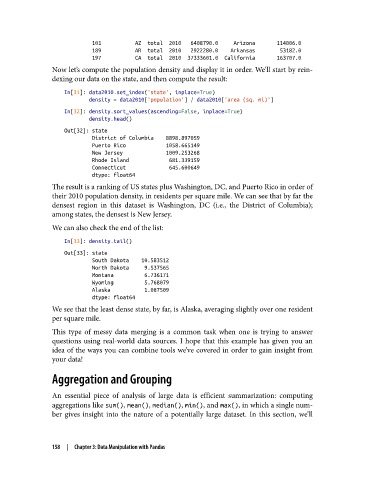
               Now let’s compute the population density and display it in order. We’ll start by rein‐
               dexing our data on the state, and then compute the result:
                   In[31]: data2010.set_index('state', inplace=True)
                           density = data2010['population'] / data2010['area (sq. mi)']
                   In[32]: density.sort_values(ascending=False, inplace=True)
                           density.head()
                   Out[32]: state
                            District of Columbia    8898.897059
                            Puerto Rico             1058.665149
                            New Jersey              1009.253268
                            Rhode Island             681.339159
                            Connecticut              645.600649
                            dtype: float64
               The result is a ranking of US states plus Washington, DC, and Puerto Rico in order of
               their 2010 population density, in residents per square mile. We can see that by far the
               densest region in this dataset is Washington, DC (i.e., the District of Columbia);
               among states, the densest is New Jersey.
               We can also check the end of the list:

                   In[33]: density.tail()
                   Out[33]: state
                            South Dakota    10.583512
                            North Dakota     9.537565
                            Montana          6.736171
                            Wyoming          5.768079
                            Alaska           1.087509
                            dtype: float64
               We see that the least dense state, by far, is Alaska, averaging slightly over one resident
               per square mile.
               This type of messy data merging is a common task when one is trying to answer
               questions using real-world data sources.  I hope that this example has given you an
               idea of the ways you can combine tools we’ve covered in order to gain insight from
               your data!

               Aggregation and Grouping

               An essential piece of analysis of large data is efficient summarization: computing
               aggregations like sum(), mean(), median(), min(), and max(), in which a single num‐
               ber gives insight into the nature of a potentially large dataset. In this section, we’ll


               158  |  Chapter 3: Data Manipulation with Pandas

