


Page 175 - Python Data Science Handbook
P. 175
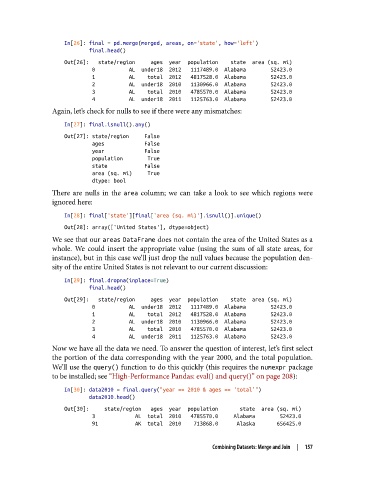
In[26]: final = pd.merge(merged, areas, on='state', how='left')
                           final.head()
                   Out[26]:   state/region     ages  year  population    state  area (sq. mi)
                            0           AL  under18  2012   1117489.0  Alabama        52423.0
                            1           AL    total  2012   4817528.0  Alabama        52423.0
                            2           AL  under18  2010   1130966.0  Alabama        52423.0
                            3           AL    total  2010   4785570.0  Alabama        52423.0
                            4           AL  under18  2011   1125763.0  Alabama        52423.0
               Again, let’s check for nulls to see if there were any mismatches:

                   In[27]: final.isnull().any()
                   Out[27]: state/region     False
                            ages             False
                            year             False
                            population        True
                            state            False
                            area (sq. mi)     True
                            dtype: bool

               There are nulls in the area  column; we can take a look to see which regions were
               ignored here:
                   In[28]: final['state'][final['area (sq. mi)'].isnull()].unique()

                   Out[28]: array(['United States'], dtype=object)
               We see that our areas DataFrame does not contain the area of the United States as a
               whole. We could insert the appropriate value (using the sum of all state areas, for
               instance), but in this case we’ll just drop the null values because the population den‐
               sity of the entire United States is not relevant to our current discussion:

                   In[29]: final.dropna(inplace=True)
                           final.head()
                   Out[29]:   state/region     ages  year  population    state  area (sq. mi)
                            0           AL  under18  2012   1117489.0  Alabama        52423.0
                            1           AL    total  2012   4817528.0  Alabama        52423.0
                            2           AL  under18  2010   1130966.0  Alabama        52423.0
                            3           AL    total  2010   4785570.0  Alabama        52423.0
                            4           AL  under18  2011   1125763.0  Alabama        52423.0
               Now we have all the data we need. To answer the question of interest, let’s first select
               the portion of the data corresponding with the year 2000, and the total population.
               We’ll use the query() function to do this quickly (this requires the numexpr package
               to be installed; see “High-Performance Pandas: eval() and query()” on page 208):
                   In[30]: data2010 = final.query("year == 2010 & ages == 'total'")
                           data2010.head()
                   Out[30]:     state/region   ages  year  population       state  area (sq. mi)
                            3             AL  total  2010   4785570.0     Alabama        52423.0
                            91            AK  total  2010    713868.0      Alaska       656425.0


                                                            Combining Datasets: Merge and Join  |  157

