


Page 313 - Python Data Science Handbook
P. 313
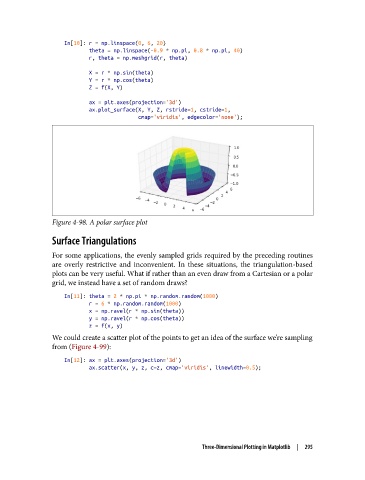
In[10]: r = np.linspace(0, 6, 20)
                           theta = np.linspace(-0.9 * np.pi, 0.8 * np.pi, 40)
                           r, theta = np.meshgrid(r, theta)

                           X = r * np.sin(theta)
                           Y = r * np.cos(theta)
                           Z = f(X, Y)

                           ax = plt.axes(projection='3d')
                           ax.plot_surface(X, Y, Z, rstride=1, cstride=1,
                                           cmap='viridis', edgecolor='none');


               Figure 4-98. A polar surface plot

               Surface Triangulations

               For some applications, the evenly sampled grids required by the preceding routines
               are overly restrictive and inconvenient. In these situations, the triangulation-based
               plots can be very useful. What if rather than an even draw from a Cartesian or a polar
               grid, we instead have a set of random draws?
                   In[11]: theta = 2 * np.pi * np.random.random(1000)
                           r = 6 * np.random.random(1000)
                           x = np.ravel(r * np.sin(theta))
                           y = np.ravel(r * np.cos(theta))
                           z = f(x, y)
               We could create a scatter plot of the points to get an idea of the surface we’re sampling
               from (Figure 4-99):

                   In[12]: ax = plt.axes(projection='3d')
                           ax.scatter(x, y, z, c=z, cmap='viridis', linewidth=0.5);


                                                         Three-Dimensional Plotting in Matplotlib  |  295

