


Page 379 - Python Data Science Handbook
P. 379
We see here a more reasonable result: the nearest-neighbor classifier is about 90%
               accurate on this holdout set. The holdout set is similar to unknown data, because the
               model has not “seen” it before.

               Model validation via cross-validation
               One disadvantage of using a holdout set for model validation is that we have lost a
               portion of our data to the model training. In the previous case, half the dataset does
               not contribute to the training of the model! This is not optimal, and can cause prob‐
               lems—especially if the initial set of training data is small.
               One way to address this is to use cross-validation—that is, to do a sequence of fits
               where each subset of the data is used both as a training set and as a validation set.
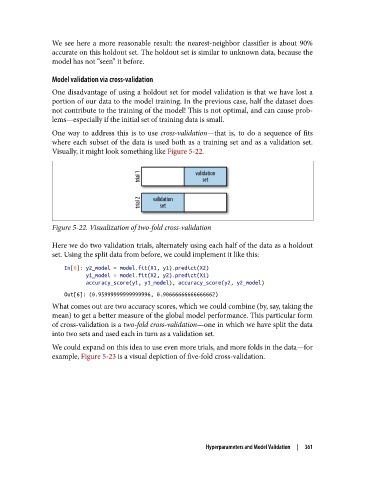
               Visually, it might look something like Figure 5-22.


               Figure 5-22. Visualization of two-fold cross-validation

               Here we do two validation trials, alternately using each half of the data as a holdout
               set. Using the split data from before, we could implement it like this:

                   In[6]: y2_model = model.fit(X1, y1).predict(X2)
                          y1_model = model.fit(X2, y2).predict(X1)
                          accuracy_score(y1, y1_model), accuracy_score(y2, y2_model)
                   Out[6]: (0.95999999999999996, 0.90666666666666662)
               What comes out are two accuracy scores, which we could combine (by, say, taking the
               mean) to get a better measure of the global model performance. This particular form
               of cross-validation is a two-fold cross-validation—one in which we have split the data
               into two sets and used each in turn as a validation set.
               We could expand on this idea to use even more trials, and more folds in the data—for
               example, Figure 5-23 is a visual depiction of five-fold cross-validation.


                                                          Hyperparameters and Model Validation  |  361

