


Page 381 - Python Data Science Handbook
P. 381
1.,  1.,  1.,  1.,  1.,  0.,  1.,  1.,  1.,  1.,  1.,  1.,  1.,
                                   1.,  1.,  1.,  1.,  1.,  1.,  1.,  1.,  1.,  1.,  1.,  1.,  1.,
                                   1.,  1.,  0.,  1.,  1.,  1.,  1.,  1.,  1.,  1.,  1.,  1.,  1.,
                                   1.,  1.,  0.,  1.,  1.,  1.,  1.,  1.,  1.,  1.,  1.,  1.,  1.,
                                   1.,  1.,  1.,  0.,  1.,  1.,  1.,  1.,  1.,  1.,  1.,  1.,  1.,
                                   1.,  1.,  1.,  1.,  1.,  1.,  1.])
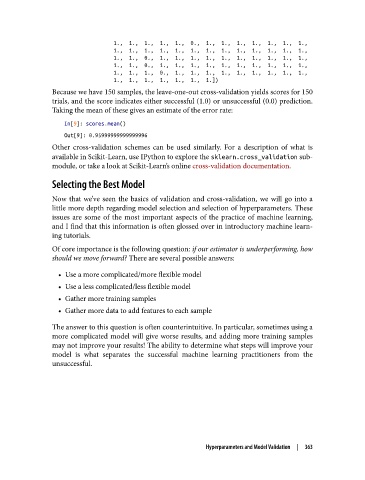
               Because we have 150 samples, the leave-one-out cross-validation yields scores for 150
               trials, and the score indicates either successful (1.0) or unsuccessful (0.0) prediction.
               Taking the mean of these gives an estimate of the error rate:

                   In[9]: scores.mean()
                   Out[9]: 0.95999999999999996
               Other cross-validation schemes can be used similarly. For a description of what is
               available in Scikit-Learn, use IPython to explore the sklearn.cross_validation sub‐
               module, or take a look at Scikit-Learn’s online cross-validation documentation.
               Selecting the Best Model

               Now that we’ve seen the basics of validation and cross-validation, we will go into a
               little more depth regarding model selection and selection of hyperparameters. These
               issues are some of the most important aspects of the practice of machine learning,
               and I find that this information is often glossed over in introductory machine learn‐
               ing tutorials.
               Of core importance is the following question: if our estimator is underperforming, how
               should we move forward? There are several possible answers:
                 • Use a more complicated/more flexible model
                 • Use a less complicated/less flexible model
                 • Gather more training samples

                 • Gather more data to add features to each sample

               The answer to this question is often counterintuitive. In particular, sometimes using a
               more complicated model will give worse results, and adding more training samples
               may not improve your results! The ability to determine what steps will improve your
               model is what separates the successful machine learning practitioners from the
               unsuccessful.


                                                          Hyperparameters and Model Validation  |  363

