


Page 380 - Python Data Science Handbook
P. 380
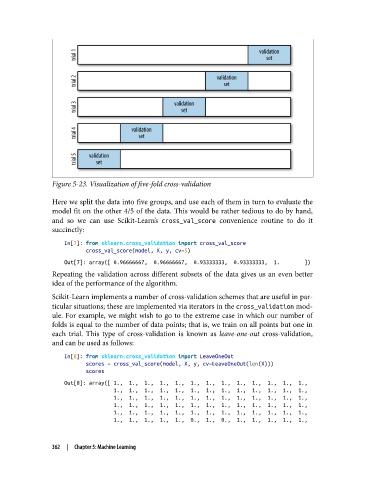
Figure 5-23. Visualization of five-fold cross-validation

               Here we split the data into five groups, and use each of them in turn to evaluate the
               model fit on the other 4/5 of the data. This would be rather tedious to do by hand,
               and so we can use Scikit-Learn’s cross_val_score  convenience routine to do it
               succinctly:
                   In[7]: from sklearn.cross_validation import cross_val_score
                          cross_val_score(model, X, y, cv=5)
                   Out[7]: array([ 0.96666667,  0.96666667,  0.93333333,  0.93333333,  1.        ])
               Repeating the validation across different subsets of the data gives us an even better
               idea of the performance of the algorithm.
               Scikit-Learn implements a number of cross-validation schemes that are useful in par‐
               ticular situations; these are implemented via iterators in the cross_validation mod‐
               ule. For example, we might wish to go to the extreme case in which our number of
               folds is equal to the number of data points; that is, we train on all points but one in
               each trial. This type of cross-validation is known as leave-one-out  cross-validation,
               and can be used as follows:

                   In[8]: from sklearn.cross_validation import LeaveOneOut
                          scores = cross_val_score(model, X, y, cv=LeaveOneOut(len(X)))
                          scores
                   Out[8]: array([ 1.,  1.,  1.,  1.,  1.,  1.,  1.,  1.,  1.,  1.,  1.,  1.,  1.,
                                   1.,  1.,  1.,  1.,  1.,  1.,  1.,  1.,  1.,  1.,  1.,  1.,  1.,
                                   1.,  1.,  1.,  1.,  1.,  1.,  1.,  1.,  1.,  1.,  1.,  1.,  1.,
                                   1.,  1.,  1.,  1.,  1.,  1.,  1.,  1.,  1.,  1.,  1.,  1.,  1.,
                                   1.,  1.,  1.,  1.,  1.,  1.,  1.,  1.,  1.,  1.,  1.,  1.,  1.,
                                   1.,  1.,  1.,  1.,  1.,  0.,  1.,  0.,  1.,  1.,  1.,  1.,  1.,


               362  |  Chapter 5: Machine Learning

