


Page 384 - Python Data Science Handbook
P. 384
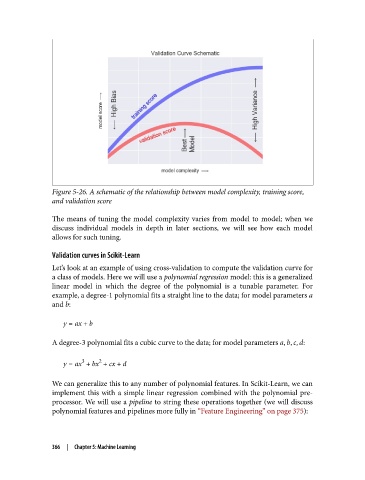
Figure 5-26. A schematic of the relationship between model complexity, training score,
               and validation score

               The means of tuning the model complexity varies from model to model; when we
               discuss individual models in depth in later sections, we will see how each model
               allows for such tuning.

               Validation curves in Scikit-Learn
               Let’s look at an example of using cross-validation to compute the validation curve for
               a class of models. Here we will use a polynomial regression model: this is a generalized
               linear model in which the degree of the polynomial is a tunable parameter. For
               example, a degree-1 polynomial fits a straight line to the data; for model parameters a
               and b:

                   y = ax + b

               A degree-3 polynomial fits a cubic curve to the data; for model parameters a, b, c, d:


                            2
                        3
                   y = ax + bx + cx + d
               We can generalize this to any number of polynomial features. In Scikit-Learn, we can
               implement this with a simple linear regression combined with the polynomial pre‐
               processor. We will use a pipeline to string these operations together (we will discuss
               polynomial features and pipelines more fully in “Feature Engineering” on page 375):


               366  |  Chapter 5: Machine Learning

