


Page 386 - Python Data Science Handbook
P. 386
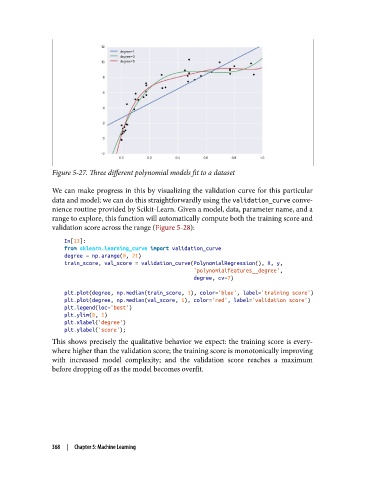
Figure 5-27. Three different polynomial models fit to a dataset

               We can make progress in this by visualizing the validation curve for this particular
               data and model; we can do this straightforwardly using the validation_curve conve‐
               nience routine provided by Scikit-Learn. Given a model, data, parameter name, and a
               range to explore, this function will automatically compute both the training score and
               validation score across the range (Figure 5-28):

                   In[13]:
                   from sklearn.learning_curve import validation_curve
                   degree = np.arange(0, 21)
                   train_score, val_score = validation_curve(PolynomialRegression(), X, y,
                                                             'polynomialfeatures__degree',
                                                             degree, cv=7)

                   plt.plot(degree, np.median(train_score, 1), color='blue', label='training score')
                   plt.plot(degree, np.median(val_score, 1), color='red', label='validation score')
                   plt.legend(loc='best')
                   plt.ylim(0, 1)
                   plt.xlabel('degree')
                   plt.ylabel('score');
               This shows precisely the qualitative behavior we expect: the training score is every‐
               where higher than the validation score; the training score is monotonically improving
               with increased model complexity; and the validation score reaches a maximum
               before dropping off as the model becomes overfit.


               368  |  Chapter 5: Machine Learning

