


Page 422 - Python Data Science Handbook
P. 422
failed to take into account (e.g., perhaps people ride less at both high and low temper‐
               atures). Nevertheless, our rough approximation is enough to give us some insights,
               and we can take a look at the coefficients of the linear model to estimate how much
               each feature contributes to the daily bicycle count:

                   In[24]: params = pd.Series(model.coef_, index=X.columns)
                           params
                   Out[24]: Mon              503.797330
                            Tue              612.088879
                            Wed              591.611292
                            Thu              481.250377
                            Fri              176.838999
                            Sat            -1104.321406
                            Sun            -1134.610322
                            holiday        -1187.212688
                            daylight_hrs     128.873251
                            PRCP            -665.185105
                            dry day          546.185613
                            Temp (C)          65.194390
                            annual            27.865349
                            dtype: float64
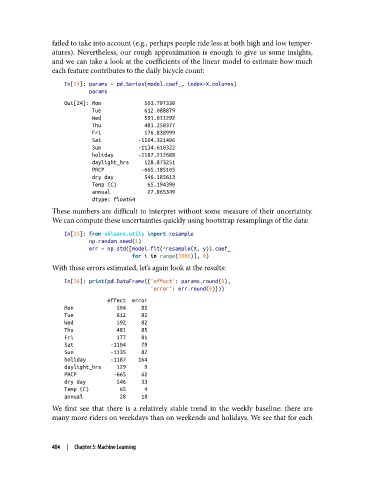
               These numbers are difficult to interpret without some measure of their uncertainty.
               We can compute these uncertainties quickly using bootstrap resamplings of the data:

                   In[25]: from sklearn.utils import resample
                           np.random.seed(1)
                           err = np.std([model.fit(*resample(X, y)).coef_
                                         for i in range(1000)], 0)
               With these errors estimated, let’s again look at the results:

                   In[26]: print(pd.DataFrame({'effect': params.round(0),
                                               'error': err.round(0)}))
                                 effect  error
                   Mon              504     85
                   Tue              612     82
                   Wed              592     82
                   Thu              481     85
                   Fri              177     81
                   Sat            -1104     79
                   Sun            -1135     82
                   holiday        -1187    164
                   daylight_hrs     129      9
                   PRCP            -665     62
                   dry day          546     33
                   Temp (C)          65      4
                   annual            28     18
               We first see that there is a relatively stable trend in the weekly baseline: there are
               many more riders on weekdays than on weekends and holidays. We see that for each


               404  |  Chapter 5: Machine Learning

