


Page 419 - Python Data Science Handbook
P. 419
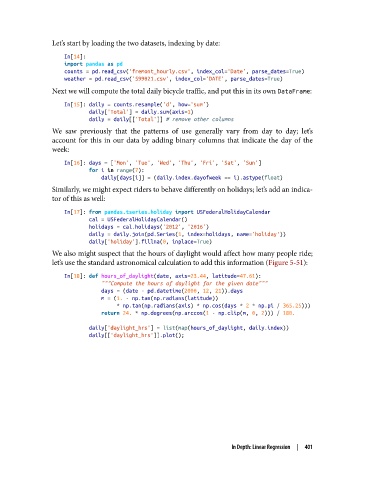
Let’s start by loading the two datasets, indexing by date:

                   In[14]:
                   import pandas as pd
                   counts = pd.read_csv('fremont_hourly.csv', index_col='Date', parse_dates=True)
                   weather = pd.read_csv('599021.csv', index_col='DATE', parse_dates=True)
               Next we will compute the total daily bicycle traffic, and put this in its own DataFrame:
                   In[15]: daily = counts.resample('d', how='sum')
                           daily['Total'] = daily.sum(axis=1)
                           daily = daily[['Total']] # remove other columns
               We saw previously that the patterns of use generally vary from day to day; let’s
               account for this in our data by adding binary columns that indicate the day of the
               week:

                   In[16]: days = ['Mon', 'Tue', 'Wed', 'Thu', 'Fri', 'Sat', 'Sun']
                           for i in range(7):
                               daily[days[i]] = (daily.index.dayofweek == i).astype(float)
               Similarly, we might expect riders to behave differently on holidays; let’s add an indica‐
               tor of this as well:

                   In[17]: from pandas.tseries.holiday import USFederalHolidayCalendar
                           cal = USFederalHolidayCalendar()
                           holidays = cal.holidays('2012', '2016')
                           daily = daily.join(pd.Series(1, index=holidays, name='holiday'))
                           daily['holiday'].fillna(0, inplace=True)
               We also might suspect that the hours of daylight would affect how many people ride;
               let’s use the standard astronomical calculation to add this information (Figure 5-51):

                   In[18]: def hours_of_daylight(date, axis=23.44, latitude=47.61):
                               """Compute the hours of daylight for the given date"""
                               days = (date - pd.datetime(2000, 12, 21)).days
                               m = (1. - np.tan(np.radians(latitude))
                                    * np.tan(np.radians(axis) * np.cos(days * 2 * np.pi / 365.25)))
                               return 24. * np.degrees(np.arccos(1 - np.clip(m, 0, 2))) / 180.

                           daily['daylight_hrs'] = list(map(hours_of_daylight, daily.index))
                           daily[['daylight_hrs']].plot();


                                                                 In Depth: Linear Regression  |  401

