


Page 418 - Python Data Science Handbook
P. 418
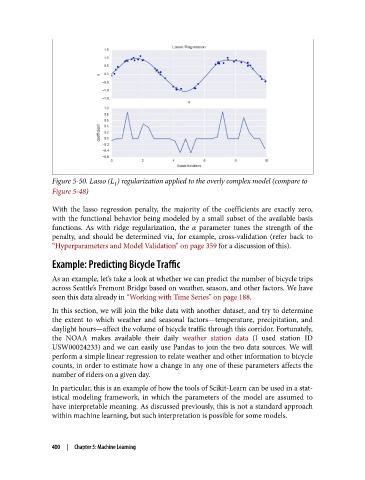
Figure 5-50. Lasso (L ) regularization applied to the overly complex model (compare to
                                 1
               Figure 5-48)

               With the lasso regression penalty, the majority of the coefficients are exactly zero,
               with the functional behavior being modeled by a small subset of the available basis
               functions. As with ridge regularization, the α  parameter tunes the strength of the
               penalty, and should be determined via, for example, cross-validation (refer back to
               “Hyperparameters and Model Validation” on page 359 for a discussion of this).
               Example: Predicting Bicycle Traffic

               As an example, let’s take a look at whether we can predict the number of bicycle trips
               across Seattle’s Fremont Bridge based on weather, season, and other factors. We have
               seen this data already in “Working with Time Series” on page 188.

               In this section, we will join the bike data with another dataset, and try to determine
               the extent to which weather and seasonal factors—temperature, precipitation, and
               daylight hours—affect the volume of bicycle traffic through this corridor. Fortunately,
               the NOAA makes available their daily weather station data  (I used station ID
               USW00024233) and we can easily use Pandas to join the two data sources. We will
               perform a simple linear regression to relate weather and other information to bicycle
               counts, in order to estimate how a change in any one of these parameters affects the
               number of riders on a given day.
               In particular, this is an example of how the tools of Scikit-Learn can be used in a stat‐
               istical modeling framework, in which the parameters of the model are assumed to
               have interpretable meaning. As discussed previously, this is not a standard approach
               within machine learning, but such interpretation is possible for some models.


               400  |  Chapter 5: Machine Learning

