


Page 428 - Python Data Science Handbook
P. 428
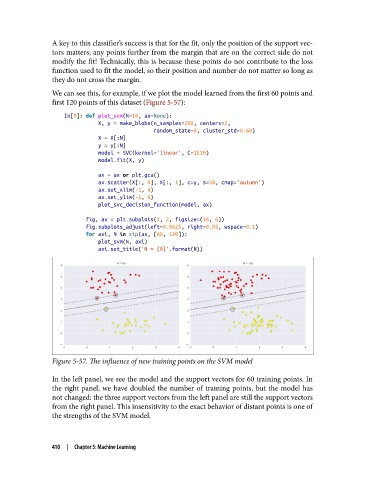
A key to this classifier’s success is that for the fit, only the position of the support vec‐
               tors matters; any points further from the margin that are on the correct side do not
               modify the fit! Technically, this is because these points do not contribute to the loss
               function used to fit the model, so their position and number do not matter so long as
               they do not cross the margin.
               We can see this, for example, if we plot the model learned from the first 60 points and
               first 120 points of this dataset (Figure 5-57):
                   In[9]: def plot_svm(N=10, ax=None):
                              X, y = make_blobs(n_samples=200, centers=2,
                                                random_state=0, cluster_std=0.60)
                              X = X[:N]
                              y = y[:N]
                              model = SVC(kernel='linear', C=1E10)
                              model.fit(X, y)

                              ax = ax or plt.gca()
                              ax.scatter(X[:, 0], X[:, 1], c=y, s=50, cmap='autumn')
                              ax.set_xlim(-1, 4)
                              ax.set_ylim(-1, 6)
                              plot_svc_decision_function(model, ax)
                          fig, ax = plt.subplots(1, 2, figsize=(16, 6))
                          fig.subplots_adjust(left=0.0625, right=0.95, wspace=0.1)
                          for axi, N in zip(ax, [60, 120]):
                              plot_svm(N, axi)
                              axi.set_title('N = {0}'.format(N))


               Figure 5-57. The influence of new training points on the SVM model

               In the left panel, we see the model and the support vectors for 60 training points. In
               the right panel, we have doubled the number of training points, but the model has
               not changed: the three support vectors from the left panel are still the support vectors
               from the right panel. This insensitivity to the exact behavior of distant points is one of
               the strengths of the SVM model.


               410  |  Chapter 5: Machine Learning

