


Page 429 - Python Data Science Handbook
P. 429
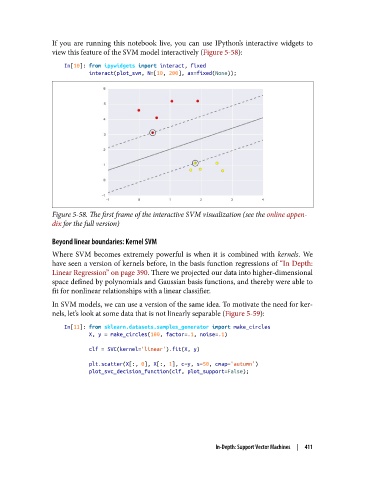
If you are running this notebook live, you can use IPython’s interactive widgets to
               view this feature of the SVM model interactively (Figure 5-58):

                   In[10]: from ipywidgets import interact, fixed
                           interact(plot_svm, N=[10, 200], ax=fixed(None));


               Figure 5-58. The first frame of the interactive SVM visualization (see the online appen‐
               dix for the full version)

               Beyond linear boundaries: Kernel SVM
               Where SVM becomes extremely powerful is when it is combined with kernels. We
               have seen a version of kernels before, in the basis function regressions of “In Depth:
               Linear Regression” on page 390. There we projected our data into higher-dimensional
               space defined by polynomials and Gaussian basis functions, and thereby were able to
               fit for nonlinear relationships with a linear classifier.

               In SVM models, we can use a version of the same idea. To motivate the need for ker‐
               nels, let’s look at some data that is not linearly separable (Figure 5-59):

                   In[11]: from sklearn.datasets.samples_generator import make_circles
                           X, y = make_circles(100, factor=.1, noise=.1)

                           clf = SVC(kernel='linear').fit(X, y)
                           plt.scatter(X[:, 0], X[:, 1], c=y, s=50, cmap='autumn')
                           plot_svc_decision_function(clf, plot_support=False);


                                                             In-Depth: Support Vector Machines  |  411

