


Page 432 - Python Data Science Handbook
P. 432
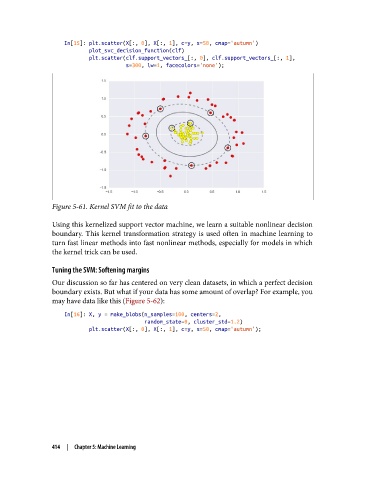
In[15]: plt.scatter(X[:, 0], X[:, 1], c=y, s=50, cmap='autumn')
                           plot_svc_decision_function(clf)
                           plt.scatter(clf.support_vectors_[:, 0], clf.support_vectors_[:, 1],
                                       s=300, lw=1, facecolors='none');


               Figure 5-61. Kernel SVM fit to the data

               Using this kernelized support vector machine, we learn a suitable nonlinear decision
               boundary. This kernel transformation strategy is used often in machine learning to
               turn fast linear methods into fast nonlinear methods, especially for models in which
               the kernel trick can be used.


               Tuning the SVM: Softening margins
               Our discussion so far has centered on very clean datasets, in which a perfect decision
               boundary exists. But what if your data has some amount of overlap? For example, you
               may have data like this (Figure 5-62):

                   In[16]: X, y = make_blobs(n_samples=100, centers=2,
                                             random_state=0, cluster_std=1.2)
                           plt.scatter(X[:, 0], X[:, 1], c=y, s=50, cmap='autumn');


               414  |  Chapter 5: Machine Learning

