


Page 468 - Python Data Science Handbook
P. 468
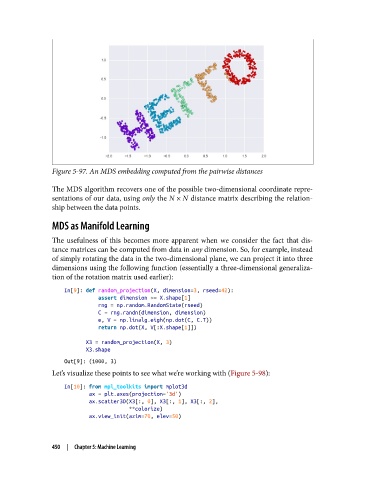
Figure 5-97. An MDS embedding computed from the pairwise distances

               The MDS algorithm recovers one of the possible two-dimensional coordinate repre‐
               sentations of our data, using only the N × N distance matrix describing the relation‐
               ship between the data points.

               MDS as Manifold Learning
               The usefulness of this becomes more apparent when we consider the fact that dis‐
               tance matrices can be computed from data in any dimension. So, for example, instead
               of simply rotating the data in the two-dimensional plane, we can project it into three
               dimensions using the following function (essentially a three-dimensional generaliza‐
               tion of the rotation matrix used earlier):

                   In[9]: def random_projection(X, dimension=3, rseed=42):
                              assert dimension >= X.shape[1]
                              rng = np.random.RandomState(rseed)
                              C = rng.randn(dimension, dimension)
                              e, V = np.linalg.eigh(np.dot(C, C.T))
                              return np.dot(X, V[:X.shape[1]])
                          X3 = random_projection(X, 3)
                          X3.shape
                   Out[9]: (1000, 3)
               Let’s visualize these points to see what we’re working with (Figure 5-98):

                   In[10]: from mpl_toolkits import mplot3d
                           ax = plt.axes(projection='3d')
                           ax.scatter3D(X3[:, 0], X3[:, 1], X3[:, 2],
                                        **colorize)
                           ax.view_init(azim=70, elev=50)


               450  |  Chapter 5: Machine Learning

