


Page 471 - Python Data Science Handbook
P. 471
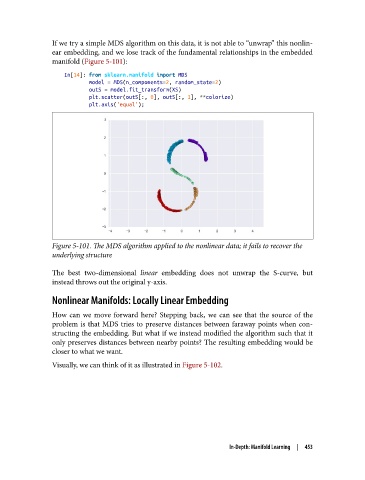
If we try a simple MDS algorithm on this data, it is not able to “unwrap” this nonlin‐
               ear embedding, and we lose track of the fundamental relationships in the embedded
               manifold (Figure 5-101):
                   In[14]: from sklearn.manifold import MDS
                           model = MDS(n_components=2, random_state=2)
                           outS = model.fit_transform(XS)
                           plt.scatter(outS[:, 0], outS[:, 1], **colorize)
                           plt.axis('equal');


               Figure 5-101. The MDS algorithm applied to the nonlinear data; it fails to recover the
               underlying structure

               The best two-dimensional linear  embedding does not unwrap the S-curve, but
               instead throws out the original y-axis.
               Nonlinear Manifolds: Locally Linear Embedding

               How can we move forward here? Stepping back, we can see that the source of the
               problem is that MDS tries to preserve distances between faraway points when con‐
               structing the embedding. But what if we instead modified the algorithm such that it
               only preserves distances between nearby points? The resulting embedding would be
               closer to what we want.
               Visually, we can think of it as illustrated in Figure 5-102.


                                                                In-Depth: Manifold Learning  |  453

