


Page 463 - Python Data Science Handbook
P. 463
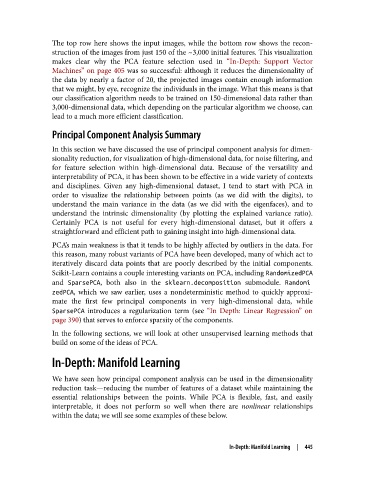
The top row here shows the input images, while the bottom row shows the recon‐
               struction of the images from just 150 of the ~3,000 initial features. This visualization
               makes clear why the PCA feature selection used in “In-Depth: Support Vector
               Machines” on page 405 was so successful: although it reduces the dimensionality of
               the data by nearly a factor of 20, the projected images contain enough information
               that we might, by eye, recognize the individuals in the image. What this means is that
               our classification algorithm needs to be trained on 150-dimensional data rather than
               3,000-dimensional data, which depending on the particular algorithm we choose, can
               lead to a much more efficient classification.

               Principal Component Analysis Summary

               In this section we have discussed the use of principal component analysis for dimen‐
               sionality reduction, for visualization of high-dimensional data, for noise filtering, and
               for feature selection within high-dimensional data. Because of the versatility and
               interpretability of PCA, it has been shown to be effective in a wide variety of contexts
               and disciplines. Given any high-dimensional dataset, I tend to start with PCA in
               order to visualize the relationship between points (as we did with the digits), to
               understand the main variance in the data (as we did with the eigenfaces), and to
               understand the intrinsic dimensionality (by plotting the explained variance ratio).
               Certainly PCA is not useful for every high-dimensional dataset, but it offers a
               straightforward and efficient path to gaining insight into high-dimensional data.
               PCA’s main weakness is that it tends to be highly affected by outliers in the data. For
               this reason, many robust variants of PCA have been developed, many of which act to
               iteratively discard data points that are poorly described by the initial components.
               Scikit-Learn contains a couple interesting variants on PCA, including RandomizedPCA
               and SparsePCA, both also in the sklearn.decomposition  submodule. Randomi
               zedPCA, which we saw earlier, uses a nondeterministic method to quickly approxi‐
               mate the first few principal components in very high-dimensional data, while
               SparsePCA  introduces a regularization term (see “In Depth: Linear Regression” on
               page 390) that serves to enforce sparsity of the components.
               In the following sections, we will look at other unsupervised learning methods that
               build on some of the ideas of PCA.

               In-Depth: Manifold Learning

               We have seen how principal component analysis can be used in the dimensionality
               reduction task—reducing the number of features of a dataset while maintaining the
               essential relationships between the points. While PCA is flexible, fast, and easily
               interpretable, it does not perform so well when there are nonlinear  relationships
               within the data; we will see some examples of these below.


                                                                In-Depth: Manifold Learning  |  445

